State of B2B SaaS AI Search Readiness (Nov 2026): Auditing 100 Public Websites
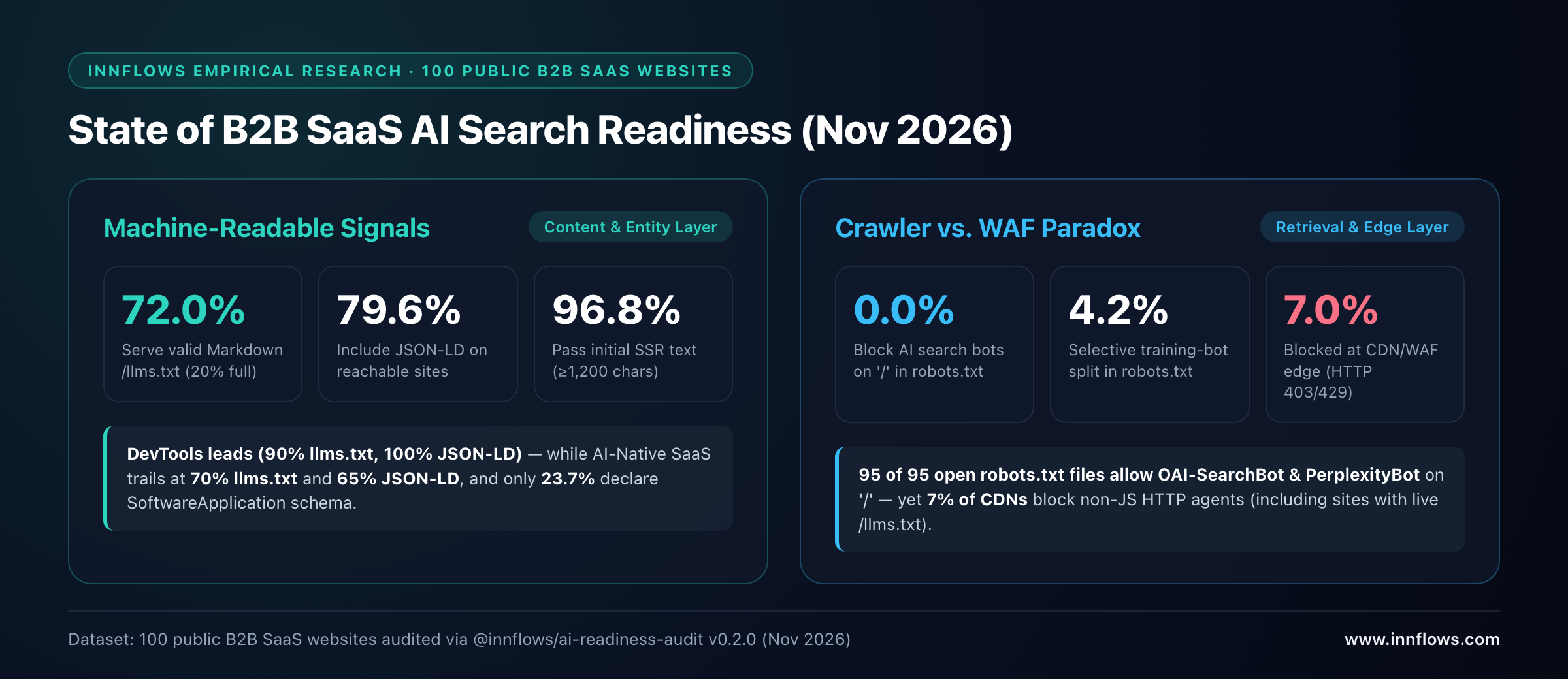
Published by Innflows Research — Based on live HTTP, robots.txt, /llms.txt, SSR HTML, and Schema.org JSON-LD audits across 100 public B2B SaaS websites conducted in November 2026 using the open-source @innflows/ai-readiness-audit CLI & MCP server.
When ChatGPT, Gemini, Claude, or Perplexity evaluates a B2B software vendor during a search-grounded buyer prompt, your homepage and root machine-discovery endpoints (/robots.txt, /llms.txt, /sitemap.xml) act as the front door for retrieval. In our companion study of 36,000+ native fan-out queries, 44.5% of ChatGPT web searches used site: domain operators—and 62.8% of those targeted official brand domains to verify pricing, product capabilities, and integrations directly from first-party pages.
Yet when a non-JavaScript HTTP retrieval agent actually hits a B2B SaaS domain, what does it find?
To establish an empirical baseline for Generative Engine Optimization (GEO) technical readiness, we audited 100 public B2B SaaS websites—stratified evenly into five 20-company cohorts across Developer Tools, AI-Native Infrastructure, Productivity & Design, CRM & Marketing, and Fintech/Security/Data. Every check was executed directly over HTTP without synthetic assumptions.

Executive Summary: Key Findings (N = 100 B2B SaaS Websites)
/llms.txtHas Crossed into Mainstream B2B SaaS Adoption (72.0%): 72 of 100 B2B SaaS root domains now serve a valid plaintext/Markdown/llms.txtfile (median length: 14,941 characters; median outbound links: 86 URLs), and 20 of 100 (20.0%) also publish an expanded/llms-full.txt. Developer Tools leads adoption at90%(18/20), while Fintech, Security & Data lags at50%(10/20).0.0%Block AI Search Crawlers inrobots.txt—Yet7.0%Block Non-JS HTTP Agents at the CDN/WAF Edge: Across the 95 sites returning a validHTTP 200/robots.txt, all 95 (100%) allow AI search and grounding bots (OAI-SearchBot,ChatGPT-User,PerplexityBot,Googlebot,Bingbot) on their root homepage (/). Only 4 of 95 (4.2%) restrict model-training bots (GPTBot,ClaudeBot,Google-Extended,Applebot-Extended). However, 7 of 100 (7.0%) block standard non-JavaScript HTTP agents at the CDN/WAF layer (5CloudflareHTTP 403+2Vercel FirewallHTTP 429challenges)—including 3 domains whoserobots.txtexplicitly permits AI crawlers and 1 domain (Freshworks) that publishes a live/llms.txtwhile403-blocking/.- The AI-Native Structured Data Paradox (
65.0%JSON-LD vs.100%in Reachable DevTools): Among the 93 HTTP-200 reachable homepages, 74 (79.6%) embed Schema.orgapplication/ld+json. Reachable Developer Tools sites achieve100%(19/19) JSON-LD coverage, whereas AI-Native & LLM Infrastructure sites score just65.0%(13/20)—with industry leaders including OpenAI, Anthropic, Hugging Face, LangChain, and Groq omitting homepage JSON-LD entirely. SoftwareApplicationSchema (23.7%) and@idEntity Anchors (53.8%) Remain Major Blind Spots: WhileOrganization(66.7%) andWebSite(50.5%) schemas are widespread across the 93 reachable homepages, 76.3% (71/93) omitSoftwareApplicationschema, 96.8% (90/93) omitFAQPageschema, and 46.2% (43/93) lack stable@identity URIs to connect their knowledge-graph nodes.- SPA Soft-404 Traps Pollute Machine Endpoints (
5.0%on/llms-full.txt): On 1% of/llms.txtendpoints and 5% of/llms-full.txtendpoints, single-page web apps returnHTTP 200 OKwith a client-siderouter shell instead of anHTTP 404—causing naive ingestion scripts to index empty HTML shells as product documentation.
Methodology & Stratified 100-SaaS Cohort
We selected a pre-registered cohort of 100 public B2B SaaS root domains, balanced evenly across five software categories (20 websites per category):
- DevTools & Cloud Infra (
n = 20): Vercel, Supabase, Stripe, Cloudflare, Datadog, Sentry, Postman, Render, Railway, PlanetScale, Neon, Resend, Clerk, WorkOS, PostHog, LaunchDarkly, Algolia, Sanity, Contentful, Prisma. - AI-Native & LLM Infra (
n = 20): Anthropic, OpenAI, Cohere, Mistral AI, Cursor, Replit, ElevenLabs, Runway, Pinecone, Weaviate, LangChain, Hugging Face, Together AI, Fireworks AI, Groq, Replicate, Arize AI, Weights & Biases, Deepgram, AssemblyAI. - Productivity & Design (
n = 20): Notion, Linear, Figma, Slack, Asana, monday.com, ClickUp, Airtable, Miro, Loom, Calendly, Coda, Zapier, Make, Retool, Webflow, Framer, Canva, Pitch, Raycast. - CRM, Marketing & Analytics (
n = 20): HubSpot, Intercom, Zendesk, Gong, Apollo.io, Clay, Attio, Customer.io, Braze, Klaviyo, Ahrefs, Semrush, Hotjar, Amplitude, Mixpanel, Twilio Segment, Salesloft, Outreach, Freshworks, Front. - Fintech, Security & Data (
n = 20): Ramp, Brex, Deel, Rippling, Gusto, Mercury, Carta, Vanta, Drata, Snyk, 1Password, Tailscale, Okta, CrowdStrike, Snowflake, Databricks, Confluent, MongoDB, Elastic, HashiCorp.
Each domain was evaluated across nine deterministic checks implemented in @innflows/ai-readiness-audit (v0.2.0):
- Non-JS HTTP Reachability: Clean
HTTP 200delivery on/without browser JavaScript challenge walls (403/429). - Indexability Directive: Absence of blocking
noindexdirectives inorX-Robots-TagHTTP headers. - SSR HTML Text Extractability: At least
1,200visible body characters in raw initial HTML after stripping,, andblocks. - Canonical URL Declaration: Presence of a valid
tag. - Title & Meta Description: Non-empty
andsummary tags. - Schema.org JSON-LD: Valid
application/ld+jsonstructured data (plus secondary tracking of@typedistribution and@identity URIs). - AI Crawler
robots.txtPosture: Root homepage (/) access across 9 major crawlers (OAI-SearchBot,ChatGPT-User,PerplexityBot,Googlebot,Bingbot,GPTBot,Google-Extended,ClaudeBot,Applebot-Extended), evaluated under RFC 9309 including end-anchoredAllow: /$rules. /llms.txtMachine Summary: HTTP200delivery of genuine plaintext/Markdown content (> 80chars), explicitly filtering outSPA soft-404 fallbacks (with/llms-full.txtmeasured in parallel).- XML Sitemap Discovery: Valid XML
entries at/sitemap.xmlor explicitSitemap:declarations inside/robots.txt.
Across all 100 websites, the mean readiness score was 87.7 / 100 (93.4 / 100 among the 93 HTTP-200 reachable websites), with 60 of 100 (60.0%) passing all nine checks.
Finding 1: Vertical Benchmark — DevTools Leads (94.5), While Fintech & Security Suffers 25% Edge Blocking
Readiness varies sharply by buyer persona and security posture across the five SaaS categories:

B2B SaaS Category (n = 20 each) | HTTP 200 Reachable | Valid /llms.txt | Valid /llms-full.txt | JSON-LD (% of All 20) | JSON-LD (% of Reachable) | Mean Score (/ 100) | 100/100 Sites |
|---|---|---|---|---|---|---|---|
| DevTools & Cloud Infra | 95% (19/20) | 90% (18/20) | 45% (9/20) | 95% (19/20) | 100.0% (19/19) | 94.5 | 18 / 20 |
| CRM, Marketing & Analytics | 95% (19/20) | 85% (17/20) | 15% (3/20) | 90% (18/20) | 94.7% (18/19) | 93.3 | 14 / 20 |
| AI-Native & LLM Infra | 100% (20/20) | 70% (14/20) | 10% (2/20) | 65% (13/20) | 65.0% (13/20) | 89.5 | 11 / 20 |
| Productivity & Design | 100% (20/20) | 65% (13/20) | 15% (3/20) | 70% (14/20) | 70.0% (14/20) | 89.0 | 10 / 20 |
| Fintech, Security & Data | 75% (15/20) | 50% (10/20) | 15% (3/20) | 50% (10/20) | 66.7% (10/15) | 72.2 | 7 / 20 |
All Audited SaaS (N = 100) | 93% (93/100) | 72% (72/100) | 20% (20/100) | 74% (74/100) | 79.6% (74/93) | 87.7 | 60 / 100 |
Three structural patterns explain the 22.3-point spread between Developer Tools (94.5) and Fintech, Security & Data (72.2):
- Developer-focused teams build directly for coding agents and MCP workflows: 90% (
18/20) of DevTools companies publish/llms.txtand 45% (9/20)—including Supabase, Cloudflare, Postman, Render, Neon, Resend, Clerk, WorkOS, and Prisma—publish full-corpus/llms-full.txtbundles so Cursor, Claude Code, and ChatGPT can ingest documentation without HTML scraping noise. - Marketing and SEO maturity drives CRM/Analytics structured data: Growth-oriented SaaS vendors (HubSpot, Intercom, Zendesk, Klaviyo, Semrush, Gong) combine high
/llms.txtadoption (85%) with near-universal JSON-LD (94.7%of reachable sites). - Aggressive WAF bot mitigation penalizes Fintech, Security & Enterprise Data: Exactly 5 of the 7 edge-blocked domains in the entire study (
25%of the cohort) sit in Fintech, Security & Data (Gusto,Carta,Drata,Snowflake, andHashiCorp), pulling the category mean score down to72.2.
Finding 2: The Crawler Access Paradox — 0% robots.txt Search Blocks vs. 7% Unintended WAF Blocks
Public commentary around AI crawlers often assumes B2B companies are locking AI engines out via robots.txt. Live inspection of all 95 HTTP-200 /robots.txt files shows the exact opposite:

Crawler User-Agent | Primary Role | Allowed on / (n = 95) | Blocked on / (n = 95) | Explicitly Named in robots.txt |
|---|---|---|---|---|
OAI-SearchBot | ChatGPT Search indexing & citations | 95 / 95 (100.0%) | 0 / 95 (0.0%) | 12 / 95 (12.6%) |
ChatGPT-User | Live user-triggered ChatGPT browsing | 95 / 95 (100.0%) | 0 / 95 (0.0%) | 14 / 95 (14.7%) |
PerplexityBot | Perplexity search indexing | 95 / 95 (100.0%) | 0 / 95 (0.0%) | 15 / 95 (15.8%) |
Googlebot / Bingbot | Google Gemini / Copilot search index | 95 / 95 (100.0%) | 0 / 95 (0.0%) | 4 / 6 (4.2% / 6.3%) |
Applebot-Extended | Apple Intelligence model training | 94 / 95 (98.9%) | 1 / 95 (1.1%) | 7 / 95 (7.4%) |
Google-Extended | Gemini model training opt-out token | 93 / 95 (97.9%) | 2 / 95 (2.1%) | 12 / 95 (12.6%) |
ClaudeBot | Anthropic model training | 93 / 95 (97.9%) | 2 / 95 (2.1%) | 14 / 95 (14.7%) |
GPTBot | OpenAI model training | 92 / 95 (96.8%) | 3 / 95 (3.2%) | 15 / 95 (15.8%) |
Surgical Training-vs-Retrieval Splitting in Production
Not a single audited B2B SaaS robots.txt (0/95) blocks OAI-SearchBot, ChatGPT-User, or PerplexityBot from reading its homepage. Every single restriction we observed (4/95 = 4.2%) is a deliberate split between foundation-model training and live AI search citations:
- Together AI leaves
User-agent: * / Allow: /open for all search crawlers while adding an explicit# Google (block AI training only)rule (User-agent: Google-Extended / Disallow: /). - Loom blocks
GPTBot(Disallow: /) and restricts Amazon crawlers only from user-recorded/share/links while keeping marketing pages open. - Canva explicitly declares
Allow: /forPerplexityBotandPerplexity-Userwhile restrictingGPTBot,ClaudeBot, andApplebot-Extendedto curated product directories (/create/,/features/,/learn/,/developers/). - Figma deploys the most granular RFC 9309 policy in the cohort: it blocks
GPTBotandClaudeBotglobally exceptAllow: /pricing/$andAllow: /pricing-faq/$(ensuring even pre-training corpora record accurate pricing), while grantingOAI-SearchBot,ChatGPT-User,PerplexityBot, andClaude-SearchBotexplicitAllow: /$access to the homepage, localized landing pages,/pricing/$,/best-practices/, and/customers/case studies while protecting user-generated/file/and/board/paths.
Policy-vs-Edge Contradictions at the CDN Layer
While SEO and growth teams carefully welcome AI search crawlers in robots.txt, security and infrastructure teams frequently override that intent at the CDN edge:
- 5 domains (
5.0%)—Freshworks,Gusto,Carta,Drata, andSnowflake—return CloudflareHTTP 403 Forbiddento standard non-JavaScript HTTP clients (and even unauthenticated headless TLS fingerprints without browser clearance cookies). - 2 domains (
2.0%)—ContentfulandHashiCorp—return Vercel FirewallHTTP 429JavaScript checkpoints across/,/robots.txt, and/llms.txt. - Most tellingly, 3 of the 7 edge-blocked domains (
Freshworks,Carta, andSnowflake) serve anHTTP 200/robots.txtthat permits AI search crawlers—andFreshworkseven serves a validHTTP 200/llms.txt—while their WAF returns403 Forbiddenthe moment an HTTP agent requests/. Unless your CDN explicitly allowlists verified AI search bot IP ranges (OAI-SearchBot,ChatGPT-User,PerplexityBot,Googlebot,Bingbot),robots.txtAllowdirectives cannot prevent silent citation loss.
Finding 3: Entity Disambiguation Gaps — 65% JSON-LD in AI-Native SaaS and 76.3% Missing SoftwareApplication
When AI search engines synthesize comparison tables ("Best enterprise feature flag tools" or "Self-serve GEO platforms under $200/mo"), structured Schema.org JSON-LD anchors who the vendor is (Organization), what software category and pricing model it offers (SoftwareApplication), and which external profiles belong to the same entity (sameAs + @id).

Across the 93 HTTP-200 reachable B2B SaaS homepages, structured data implementation drops off steeply beyond basic corporate identity:
Schema.org Signal / @type | Reachable SaaS Sites (n = 93) | Share of Reachable (%) | Share of All Cohort (N = 100) |
|---|---|---|---|
Any application/ld+json Present | 74 / 93 | 79.6% | 74.0% |
Organization | 62 / 93 | 66.7% | 62.0% |
Includes Stable @id Entity Anchor | 50 / 93 | 53.8% | 50.0% |
WebSite | 47 / 93 | 50.5% | 47.0% |
WebPage | 23 / 93 | 24.7% | 23.0% |
SoftwareApplication | 22 / 93 | 23.7% | 22.0% |
Corporation / Product | 5 / 4 | 5.4% / 4.3% | 5.0% / 4.0% |
FAQPage | 3 / 93 | 3.2% | 3.0% |
Two findings stand out for B2B technical marketers:
- AI-Native SaaS is the least structured reachable cohort (
65.0%JSON-LD): Ironically, the companies building LLMs and AI developer infrastructure (OpenAI,Anthropic,Hugging Face,LangChain,Groq,Replicate,AssemblyAI) rely heavily on brand authority and minimalist design—leaving35%of AI-Native homepages with zeroapplication/ld+json. For challenger B2B SaaS brands that do not enjoy OpenAI-scale pre-training priors, copying minimalist, schema-free landing pages makes category disambiguation substantially harder. 76.3%of reachable SaaS homepages omitSoftwareApplicationschema: PublishingOrganizationalone tells search engines a company exists, but omitsapplicationCategory,operatingSystem,featureList, andofferspricing metadata—the exact structured fields AI assistants extract when filtering software shortlists.
Finding 4: Inside /llms.txt at Scale — 14.9 KB Median Size & the SPA Soft-404 Trap
Proposed as a lightweight Markdown index for language models, /llms.txt has moved decisively beyond early-adopter experimentation in B2B SaaS:
- 72 of 100 (
72.0%) audited SaaS domains serve a valid Markdown/plaintext/llms.txtat the root origin, containing a median of 14,941 characters (mean:71,005chars, ranging from concise414-char overviews up to1.49 MBfull-catalog indexes) and a median of 86 outbound links to product docs, API references, and pricing pages. - 20 of 100 (
20.0%) also maintain/llms-full.txtfor single-fetch context loading. - Watch out for SPA Soft-404s (
HTTP 200+): On1/llms.txtendpoint (Weights & Biases) and5/llms-full.txtendpoints (5.0%), unrouted paths fall through to a React/Next.js client app shell withHTTP 200 OKandContent-Type: text/html. Any audit or ingestion pipeline that checksstatus === 200without verifying plaintext/Markdown structure will misclassify broken SPA fallbacks as validllms.txtfiles.
Meanwhile, SSR HTML text extractability is now strong across reachable B2B SaaS (90/93 = 96.8% deliver ≥ 1,200 visible characters in initial HTML), 94.6% (88/93) declare , 98.9% (92/93) include both and , and 97.0% (97/100) expose XML sitemaps (85 directly at /sitemap.xml plus 12 via Sitemap: directives in /robots.txt). Only 3 reachable sites (3.2%) fell into the thin-SSR warning band (300–1,199 visible characters) due to canvas-heavy or ultra-minimalist homepages.
Practical Technical Checklist: Auditing Your Own SaaS Domain
You can run the exact 9-check audit used in this benchmark against your own homepage or pricing page in five seconds using our zero-dependency open-source CLI (or wire it directly into Claude Code, Cursor, or Antigravity as an MCP server):
# Instant CLI check (Node.js 18+, zero dependencies)
npx @innflows/ai-readiness-audit https://yourdomain.com --json
# Or register as a local Model Context Protocol (MCP) server
npx -y @innflows/ai-readiness-audit --mcp
Based on the failure modes observed across these 100 B2B SaaS websites, prioritize four high-leverage fixes:
- Test your homepage from a non-JavaScript HTTP client—not just Chrome: Verify that Cloudflare Bot Fight Mode or Vercel Firewall does not return
HTTP 403/429toOAI-SearchBot,ChatGPT-User, andPerplexityBotwhile yourrobots.txtsaysAllow: /. - Split training vs. search crawlers explicitly instead of blanket-blocking AI: If legal policy requires opting out of foundation-model training (
GPTBot,Google-Extended,ClaudeBot), keepOAI-SearchBot,ChatGPT-User, andPerplexityBotexplicitly allowed on/,/platform,/pricing, and/docs—following the surgical pattern used by Figma, Canva, and Together AI. - Ship a clean
text/plain/llms.txt(and verify/llms-full.txtreturns404if unused, not an HTML200shell): Summarize your product category, core capabilities, transparent pricing tiers, and canonical documentation URLs in 5–20 KB of structured Markdown. - Upgrade homepage JSON-LD from bare
Organizationto@id-linkedSoftwareApplication+FAQPage: Anchor your brand entity with a stable@idURI, verifiedsameAslinks (GitHub, LinkedIn, G2, Shopify/Marketplace listings), explicitSoftwareApplicationcategory/pricing metadata, and crawlable SSRFAQPageanswers.
Technical readiness ensures AI search engines can crawl and parse your site—continuous multi-engine monitoring verifies whether they actually recommend and cite your brand on high-intent buyer prompts. Explore Innflows Website AI-Readiness Audit and AI Visibility Monitoring to benchmark your citation share across ChatGPT, Gemini, Perplexity, Claude, and Google AI Overviews.
Frequently Asked Questions
How many B2B SaaS websites have adopted llms.txt in late 2026?
In our November 2026 audit of 100 public B2B SaaS websites across five verticals, 72% (72/100) serve a valid plaintext/Markdown /llms.txt file (with a median size of 14,941 characters and 86 outbound links), and 20% (20/100) also publish /llms-full.txt. Adoption is highest in Developer Tools & Cloud Infrastructure (90%) and CRM, Marketing & Analytics (85%).
Do B2B SaaS websites block ChatGPT or Perplexity in robots.txt?
No—among the 95 audited SaaS domains serving an HTTP 200 /robots.txt, 0% (0/95) block AI search/grounding crawlers (OAI-SearchBot, ChatGPT-User, PerplexityBot, Googlebot, Bingbot) on their root homepage (/). Only 4.2% (4/95) restrict model-training bots (GPTBot, ClaudeBot, Google-Extended, Applebot-Extended) while keeping search/citation crawlers allowed. However, 7% (7/100) block non-JavaScript HTTP agents at the CDN/WAF edge (HTTP 403 or 429), often contradicting their own robots.txt policy.
What structured data is most commonly missing on B2B SaaS homepages?
While 79.6% (74/93) of HTTP-200 reachable B2B SaaS homepages include at least one Schema.org JSON-LD block (most commonly Organization at 66.7% and WebSite at 50.5%), 76.3% (71/93) omit SoftwareApplication schema, 46.2% (43/93) omit @id entity URI anchors, and 96.8% (90/93) omit FAQPage schema on the homepage.