How ChatGPT and Gemini Actually Search the Web: Analyzing 36,000+ Native Fan-Out Queries
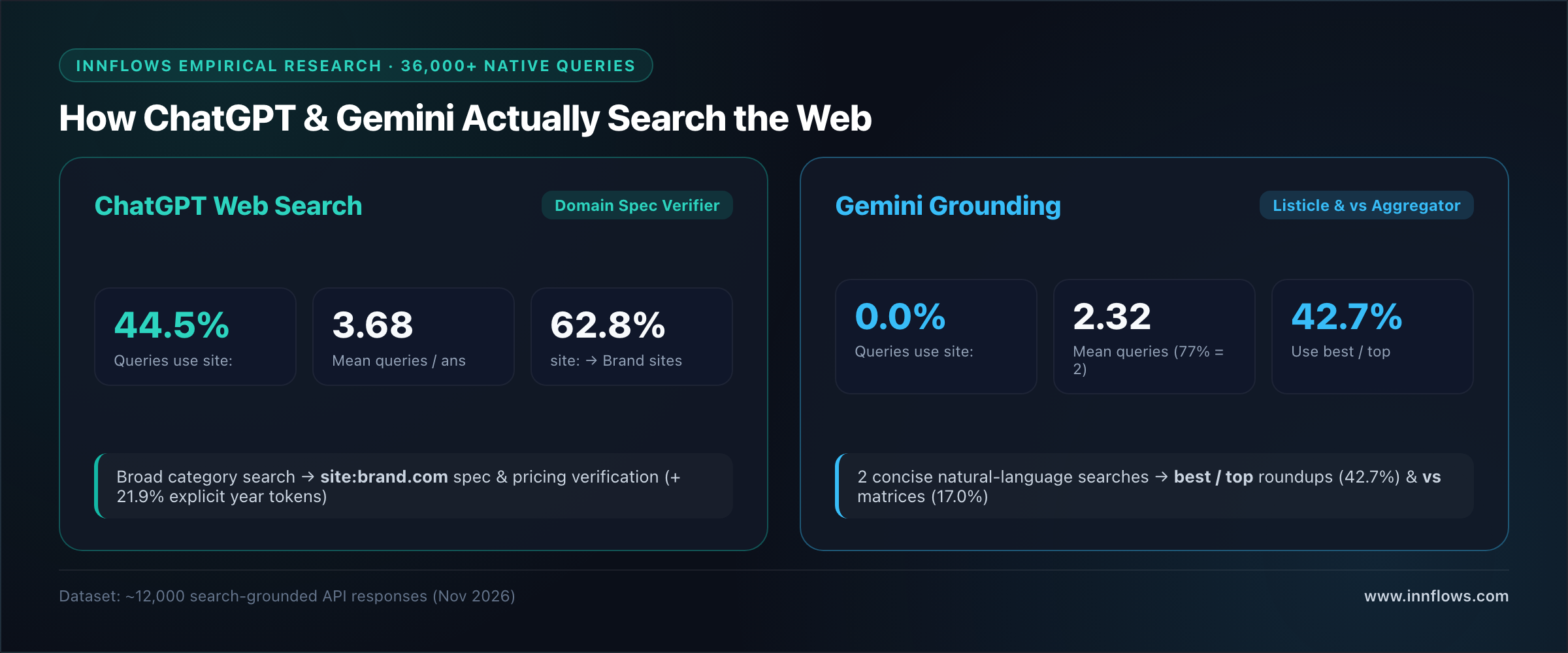
Published by Innflows Research (www.innflows.com) — Based on 36,000+ provider-level web search queries captured across ~12,000 search-grounded AI responses through November 2026.
When a buyer asks an AI assistant an open-ended question—such as "What are the best over-ear noise-cancelling headphones for frequent flyers?" or "Which issue tracking tool is better for a software team, Linear or Jira?"—the model rarely searches the user's prompt verbatim. Instead, it rewrites the prompt into one or more underlying search queries, a retrieval step known as query fan-out.
Most Generative Engine Optimization (GEO) advice treats AI search engines as a monolith. To test whether major platforms actually retrieve web evidence the same way, Innflows analyzed more than 36,000 native fan-out queries across roughly 12,000 search-grounded API responses spanning ChatGPT (OpenAI Responses API with web search), Gemini (Flash-tier model with Google Search grounding), and directional exploratory subsamples (n < 150 responses each) on DeepSeek and Grok.
The data reveals a sharp architectural divide: ChatGPT behaves like a domain-targeted specification verifier (44.5% of all queries use site:), whereas Gemini behaves like a listicle and comparison aggregator (0.0% site: usage, 42.7% best/top queries, and 17.0% vs/comparison queries).
Dataset and Methodology
All query strings in this study were recorded from provider-returned web search traces across aggregated, de-identified monitoring and benchmark evaluations covering unbranded category discovery questions and head-to-head brand comparison questions across consumer hardware, personal care, and B2B services:
- ChatGPT (OpenAI Responses API with web search):
~6,100search-grounded responses generating22,000+native queries. - Gemini (Google Search grounding):
~5,600search-grounded responses generating13,000+native queries. - Exploratory Subsamples: Small directional samples (
n < 150responses each) on DeepSeek (native search tool calls) and Grok (web-grounded API responses), observed qualitatively alongside the two primary engines.
Methodological note: Observations reflect provider search-grounded API pipelines (~96%–100% search trigger rate across valid batches); logged-in consumer web or mobile apps may apply additional session personalization or UI routing. All metrics below are reported strictly as cross-category aggregates; concrete prompt examples are freshly executed public benchmark prompts.
Finding 1: Query Budgets and Modifiers Diverge Sharply by Engine
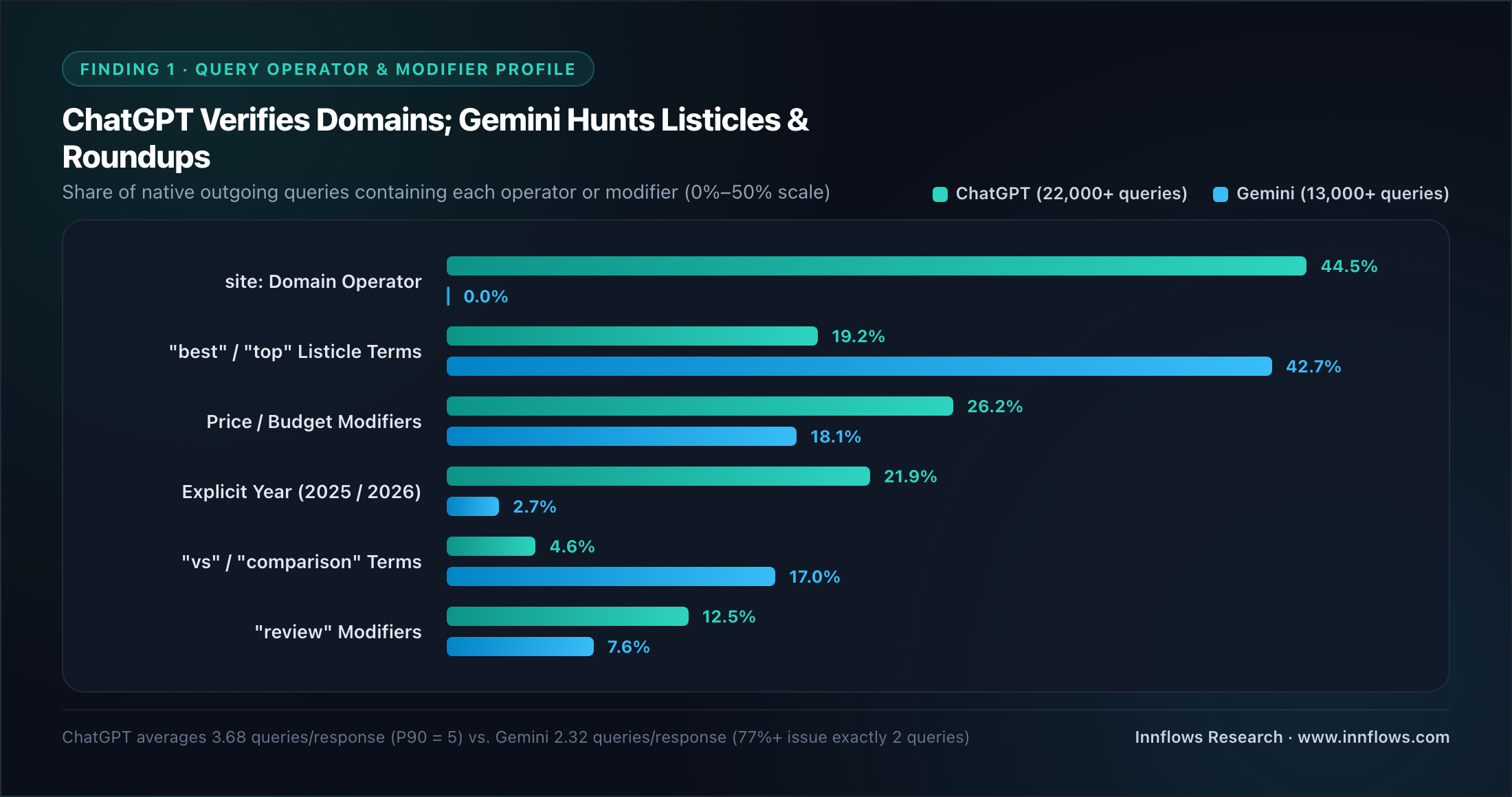
Across ~12,000 responses, ChatGPT and Gemini exhibit fundamentally different query budgets, lengths, and search operators.
| Metric | ChatGPT (OpenAI Web Search) | Gemini (Google Grounding) |
|---|---|---|
| Analyzed Scale | ~6,100 answers / 22,000+ queries | ~5,600 answers / 13,000+ queries |
| Mean Queries per Answer | 3.68 | 2.32 |
| Median / P90 Queries | 3.0 / 5 | 2.0 / 3 |
| Mean Query Length | 9.5 words (70.5 chars) | 7.9 words (51.1 chars) |
site: Operator Share | 44.5% | 0.0% |
best / top Modifier Share | 19.2% | 42.7% |
vs / comparison Share | 4.6% | 17.0% |
| Price / Budget Modifier Share | 26.2% | 18.1% |
Explicit Year (2025/2026) | 21.9% | 2.7% |
| Review Modifier Share | 12.5% | 7.6% |
| Certification / Standard Code | 9.7% | 10.7% |
(In smaller exploratory subsamples on DeepSeek and Grok, neither engine used site: operators; both averaged roughly 3 queries per response and leaned more heavily on explicit review and comparison modifiers.)
Three structural takeaways stand out immediately:
- Gemini rarely fires follow-up searches: Over
77%of Gemini responses issue exactly 2 Google search queries, and roughly90%issue 3 or fewer. Because Gemini seldom runs second-round verification queries, a brand that misses the top organic Google results on those two broad listicle or comparison searches rarely enters Gemini's synthesis window. - ChatGPT runs multi-step verification: Nearly
79%of ChatGPT responses issue 3 or 4 queries, and complex comparisons expand up to6–13queries. ChatGPT routinely pairs 1–2 broad discovery searches with 2–3 domain-restrictedsite:lookups. - Explicit year tokens appear 8x more often on ChatGPT than on Gemini: ChatGPT appends explicit year markers (
2025or2026) in21.9%of its queries, compared with2.7%on Gemini (where Google Search's ranking layer already weights document freshness).
Finding 2: Inside ChatGPT's 44.5% site: Operator Habit
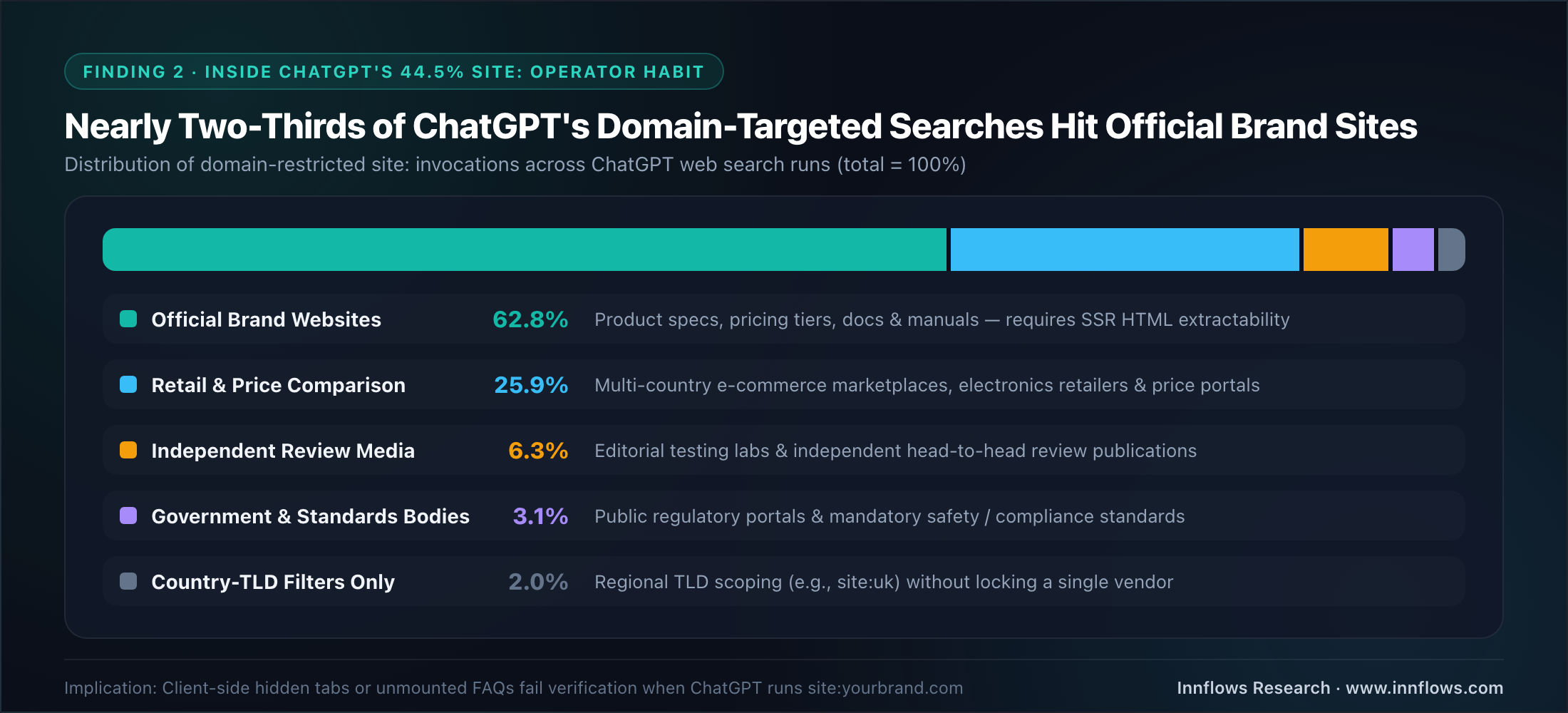
Roughly 44.5% of all native ChatGPT search queries explicitly restrict search results to specific domains or top-level domains across hundreds of distinct websites. Grouping targeted domains by role clarifies what ChatGPT treats as primary evidence:
site: Target Category | Share of ChatGPT site: Calls | Typical Destinations | Primary Verification Goal |
|---|---|---|---|
| Official Brand Websites | 62.8% | Manufacturer and SaaS vendor product, pricing, specification, and documentation pages | Verify official technical specs, plan limits, regional availability, and product manuals |
| Retail & Price Comparison | 25.9% | Multi-country e-commerce marketplaces, major electronics/big-box retailers, and price-comparison portals | Cross-check street pricing, SKU availability, and buyer review distributions |
| Independent Review Media | 6.3% | Major editorial testing labs and independent consumer review publications | Pull third-party test verdicts on head-to-head product comparisons |
| Government & Standards Bodies | 3.1% | Public regulatory portals and official standards organizations | Confirm mandatory safety or industry compliance codes |
| Country-TLD Filters Only | 2.0% | Regional top-level domain filters (such as site:uk) | Scope results to a target geography without locking a single vendor |
Why Client-Side Hidden Content Hurts ChatGPT Citations
Because 62.8% of ChatGPT's site: queries target first-party brand websites—often probing specific sub-attributes such as site:example.com pricing plan limits or site:example.com technical specifications—pages that unmount secondary product tabs or FAQ answers behind client-side state (for example, {activeTab === 'specs' && ) fail verification even when ChatGPT intentionally searches your domain. Auditing initial server-rendered HTML extractability—via tools like the open-source website-ai-readiness-audit CLI or Innflows' Website AI-Readiness Audit—directly protects this first-party lookup channel.
Finding 3: Gemini's 0% site: Rule and the Comparison Bottleneck
Across 13,000+ native Gemini queries, site: appeared 0.0% of the time. Instead, Gemini relies on Google Search's organic top rankings for listicle and comparison queries:
42.7%of Gemini queries includebestortop(more than double ChatGPT's19.2%).17.0%includevsorcomparison(nearly 3.7x ChatGPT's4.6%).
Running a public software comparison prompt ("Which issue tracking and project management tool is better for a software team, Linear or Jira?") illustrates how differently the two engines decompose the exact same question:
- Gemini (
2queries): (1)Linear vs Jira comparison software development; (2)Linear vs Jira pros and cons. - ChatGPT (
3queries): (1)Linear official features issue tracking project management software teams; (2)Atlassian Jira official features software development project management issue tracking; (3)Linear Jira comparison software teams 2026.
Notice the split: Gemini immediately searches for pre-written vs and pros and cons roundups, whereas ChatGPT queries each vendor's official feature set separately before running a year-stamped (2026) comparison search. Brands that publish only single-vendor "how-to" articles without structured multi-vendor comparison tables or vs pages give Gemini's best and comparison queries nothing to rank.
Finding 4: The "Brand Prior Gate" in Unbranded Category Prompts
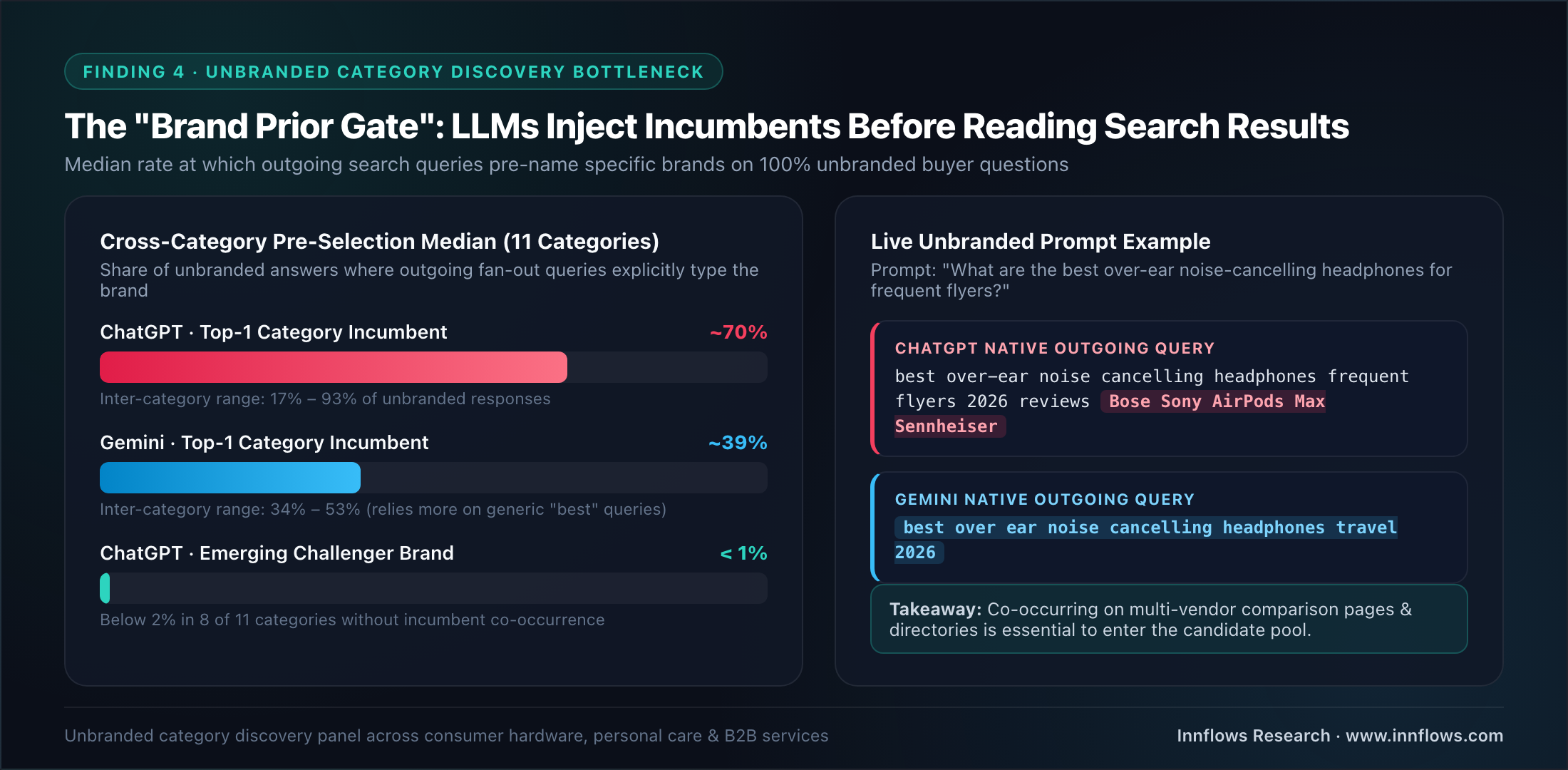
The hardest GEO challenge for emerging software and consumer brands is unbranded category discovery—earning a mention when the buyer never types your brand name.
Inspecting native fan-out queries on purely unbranded category prompts reveals a structural hurdle we call the Brand Prior Gate: before reading a single search result snippet, LLMs frequently inject pre-trained incumbent brand names directly into their outgoing search queries.
- Cross-Category Aggregate Pattern: Across 11 evaluated product and service categories, ChatGPT explicitly named the single most dominant incumbent brand in a median
~70%of unbranded responses (inter-category range17%–93%). By contrast, emerging challenger brands in those same categories were pre-selected into unbranded fan-out queries at a median rate below1%—and remained under2%in 8 of the 11 categories. - Engine Difference: Across multi-engine category evaluations on Gemini, top-1 incumbent injection into outgoing queries was substantially lower (median
~39%, range34%–53%), because Gemini leans more heavily on genericbest [category]listicle searches than on brand-named verification queries.
A live unbranded prompt ("What are the best over-ear noise-cancelling headphones for frequent flyers?"—containing zero brand names) demonstrates the Brand Prior Gate in action:
- ChatGPT (
2queries): (1)best over-ear noise cancelling headphones frequent flyers 2026 reviews Bose Sony AirPods Max Sennheiser; (2)best noise cancelling headphones airplane travel official Bose QuietComfort Ultra Sony WH-1000XM6 AirPods Max Sennheiser Momentum 4. - Gemini (
2queries): (1)best over ear noise cancelling headphones travel 2026; (2)best ANC headphones for frequent flyers.
Even though the user asked an open category question, ChatGPT pre-populated four incumbent brands—and their specific flagship model names—directly into its search queries. If a challenger brand is not yet inside the model's pre-trained top-4 prior for a category, isolated blog posts that only mention its own brand name cannot intercept incumbent-anchored searches.
Practical Playbook: Aligning GEO With Real Retrieval Mechanics
Designing content and technical SEO around observed fan-out behavior comes down to four practical principles:
- Co-occur with category incumbents on factual comparison and
vspages: Because Gemini issuesbest/top(42.7%) andvs/comparison(17.0%) queries while ChatGPT injects incumbent names into unbranded fan-out, challenger brands earn retrieval fastest through verifiable multi-vendor comparison matrices and transparent alternative guides. - Maintain accurate profiles on third-party category directories: Established software directories (such as G2, Capterra, and AlternativeTo for B2B software) and major retail marketplaces (
25.9%of ChatGPTsite:lookups) supply the multi-vendor seed lists that genericbest [category]searches surface first. - Ensure first-party specs, pricing, and FAQs render in initial SSR HTML: When ChatGPT runs
site:yourbrand.com(62.8%of allsite:calls) or searches"official features"with a2026freshness token, dedicated server-rendered product subpages, transparent pricing tables,llms.txt, andSchema.orgJSON-LD ensure crawlers extract complete facts without executing client-side tab clicks. - Separate retrieval gaps from synthesis gaps in ongoing monitoring: Aggregate mention scores hide whether your brand missed the candidate search pool entirely or was retrieved as a source URL yet omitted from the final recommendation. Tracking prompt-level fan-out queries alongside cited URLs—as supported in Innflows AI Visibility Monitoring—lets marketing teams diagnose whether to prioritize off-site directory co-occurrence, comparison content, or first-party technical fixes.
Cite This Study
Researchers, writers, and marketing teams are welcome to cite findings from this report with attribution to Innflows Research (https://www.innflows.com).