SEO Trends You Need to Know: GEO Industry Report Uncovers 3 Major Shifts in AI Search
Introduction
Three critical SEO trends reshape brand visibility as AI Overviews now trigger on 25.11% of Google searches, up from 6.49% in January 2025. So AI search traffic has surged 300% year-over-year, with ChatGPT commanding 87.4% of AI referral traffic. This transformation needs new approaches to ai search engine optimization as traditional ranking metrics fail to capture brand performance in AI-generated answers.
Our latest AEO / GEO industry report reveals how Generative Engine Optimization and Answer Engine Optimization are becoming essential marketing strategies. We'll get into how ai visibility tracking now determines competitive positioning and why 93% of AI search sessions end without website clicks. Leading brands use ai visibility platforms to dominate citations in AI ecosystems of all types.
Shift 1: AI Search Traffic Reaches Critical Mass Across Industries
AI Search Traffic Reaches Critical Mass in Industries of All Types
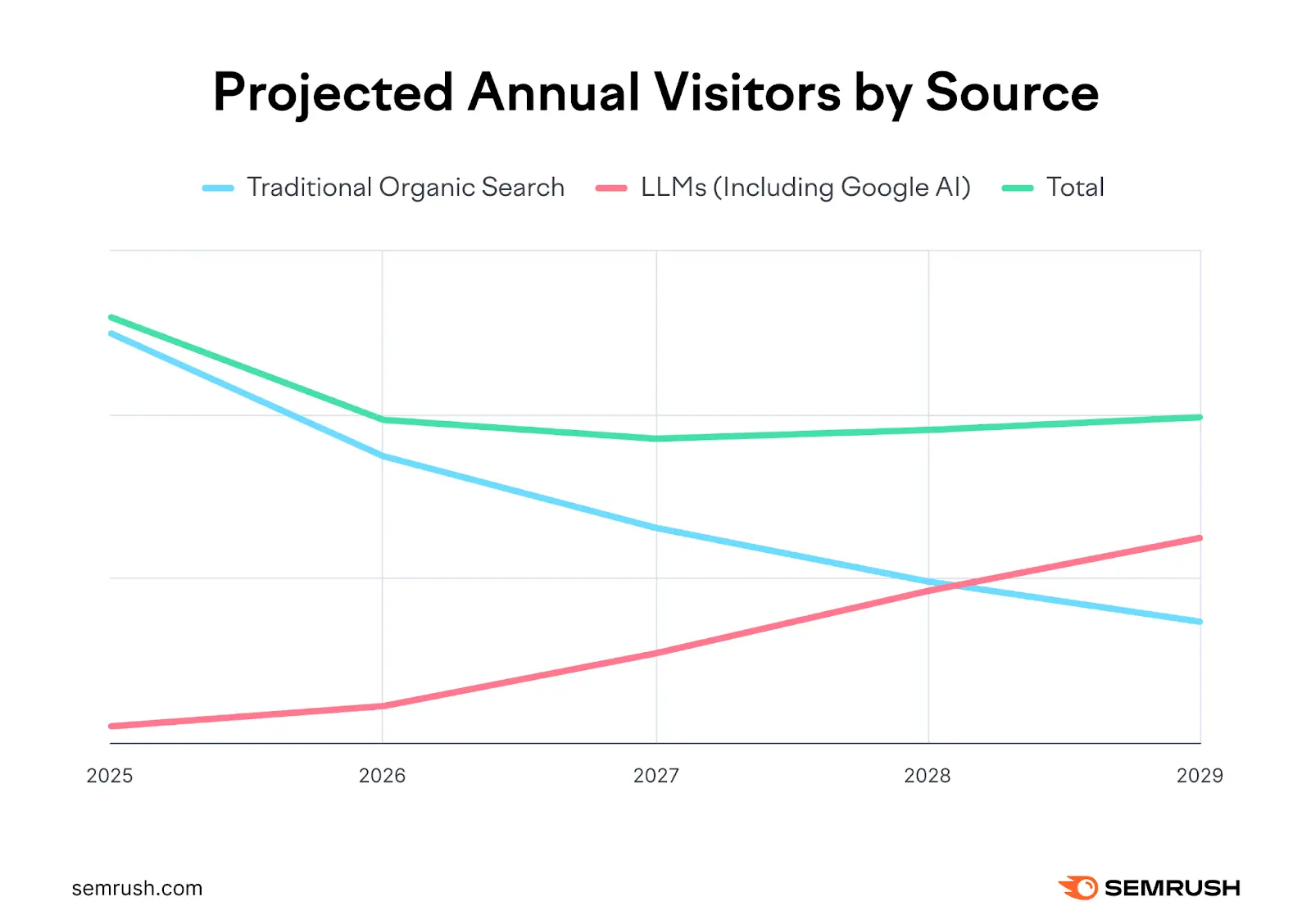
AI search platforms have moved beyond experimental status. They now deliver measurable business results in sectors of all types. The data shows traffic from large language models increased 527% year-over-year . Some websites report AI sources now account for over 1% of total sessions [1]. This might seem small when you match it for traditional search volume, but the trajectory matters more than current share.
source: semrush
ChatGPT Dominates with 87.4% of AI Referral Traffic
ChatGPT controls an overwhelming portion of AI-driven website referrals. Analysis of actual traffic patterns reveals ChatGPT accounts for 87.4% of AI referral traffic in tracked websites . Separate research confirms this dominance and shows ChatGPT holds 80.49% of the AI chatbot market share [2]. The platform drives over 77% of all AI-driven visits globally [3].
The platform's reach extends far beyond early adopters. ChatGPT now serves 700 million weekly active users [4]. This represents an 8x increase from October 2023 to April 2025 [5]. This user base makes ChatGPT the fourth most visited website globally and generates over 5 billion monthly visits [1].
Desktop usage patterns reveal where AI search activity concentrates. More than 90% of AI search referrals originate from desktop devices . ChatGPT sends 94% of its referral traffic from desktop users . Google Search stands as the lone exception and delivers 53% of its AI-driven referrals from mobile devices versus 44% from desktop [5].
Perplexity and other competitors trail by a lot in referral volume. Perplexity sends 96% of referrals from desktop , while Bing delivers 94% from desktop users [5]. Google Gemini generates only 6.4% of total AI traffic [3] despite Google's search dominance. It sends 91% of referrals from desktop [5].
Retail environments demonstrate ChatGPT's growing influence on purchase behavior. ChatGPT now drives one in five referral clicks for Walmart, up 15% from July to August . Other major retailers see similar patterns. ChatGPT generates more than 20% of referral traffic to Etsy and nearly 15% to Target . Around 2% of all ChatGPT queries involve shopping. This translates to approximately 50 million shopping-related queries daily [6].
Google AI Overviews Now Trigger on 25% of Searches
Google AI Overviews appear on 20.5% of all keywords according to analysis of 146 million search results [5]. Other tracking shows AI Overviews reaching approximately 25% of queries globally [2]. Google reports the feature now reaches 2 billion monthly users in more than 200 countries [1].
Query intent determines AI Overview appearance rates with striking consistency. Informational queries make up 99.9% of all AI Overview appearances , while navigational queries trigger the feature just 0.09% of the time . Commercial queries account for 4.3% of appearances. Transactional queries hit 2.1% [5].
YMYL (Your Money Your Life) content shows unexpectedly high trigger rates despite accuracy concerns. Medical YMYL searches trigger AI Overviews 44.1% of the time . Financial YMYL queries hit 22.9% , and safety YMYL reaches 31.0% [5]. This pattern contradicts expectations that Google would limit AI-generated answers for health and financial topics where misinformation carries serious consequences.
Query length relates directly to AI Overview probability. Searches with eight words or more are 7x more likely to generate an AI Overview [7]. One-word or two-word searches result in AI Overviews just 8% of the time. Searches with 10 words or more trigger the feature 53% of the time . Question-based queries beginning with "who," "what," "when," or "why" produce AI Overviews 60% of the time [4].
Local searches see limited AI Overview penetration. Only 7.9% of local queries display AI Overviews compared to 22.8% for non-local queries . Branded keywords show AI Overviews 13.1% of the time, while non-branded queries trigger them 24.9% of the time . This creates a 1.9x higher occurrence rate for generic searches versus brand-specific lookups [5].
Click behavior changes when AI Overviews appear. Users who encounter an AI summary click on traditional search result links in just 8% of visits . Users who don't see an AI summary click through nearly twice as often at 15% of visits . Users rarely click links within the AI summary itself and do so in only 1% of visits [4].
Organic click-through rates for informational queries with AI Overviews fell 61% since mid-2024 . Paid CTRs on those same queries dropped 68% . Even on queries without AI Overviews, organic CTRs declined 41% [8]. This suggests the problem extends beyond AI Overviews alone. Analysis of over 300,000 keywords found a connection between AI Overview presence and a 34.5% decrease in click-through rates for top-ranking pages [7].
Industry Performance Varies: Technology Leads at 1.34%
AI search traffic distribution varies by sector and content type. Publishers focused on informational content face the greatest exposure, as question-based and how-to content arranges closely with AI Overview trigger criteria [5]. Educational content publishers encounter the highest risk of traffic disruption from AI-generated answers.
B2B technology companies show the strongest AI search performance. The presence of AI Overviews for B2B tech-related queries increased from 36% to 70% of SERPs . Insurance followed with an increase from 17% to 63% . Entertainment grew from 2% to 37% [7].
Ecommerce and transactional searches remain protected from AI Overview disruption. The presence of AI Overviews in ecommerce queries declined to just 4% of ecommerce searches, down from 29% when the feature first rolled out [7]. This protection stems from Google's ad revenue priorities, as high-CPC keywords signal buying intent. Around 70% of all AI Overviews appear on keywords with a Cost Per Click under USD 1.00 [1]. More expensive keywords costing USD 10.00 or more show AI Overviews only about 17% of the time [7].
Traffic drops hit certain sectors harder than others. Nearly 39% of marketers reported traffic declines following AI Overview rollout. Technology companies were most affected at 44%, travel and hospitality at 43% [3]. Some websites experienced drops of 20-40% in overall traffic , with much of that decline coming from lost organic search traffic [2].
Amazon's strategic blocking of AI crawlers demonstrates the stakes involved. Amazon blocked many AI crawlers from scraping its site and prevented ChatGPT from providing real-time Amazon product links. This defensive move protects the backbone of Amazon's USD 56 billion advertising business . Referral traffic from ChatGPT to Amazon fell nearly 18% month-over-month to less than 3% . This pulled 600 million product listings off the agentic shopping shelf [6].
Conversion Rates from AI Search Outperform Traditional SEO
Visitors arriving from AI search platforms convert at higher rates than traditional organic search traffic. Research tracking 19 GA4 properties found the average AI search visitor is 4.4 times as valuable as the average visit from traditional organic search based on conversion rate [5].
Real-world data confirms this conversion advantage. AI search visitors convert at a 23x higher rate than traditional organic search visitors for Ahrefs . ChatGPT accounts for 12.1% of Ahrefs signups despite representing only 0.5% of total traffic . This channel delivers 12.1% of conversions from half a percent of traffic volume [9].
Conversion rates vary by AI platform. Claude shows the highest conversion rate at 16.8%, followed by ChatGPT at 14.2% . Traditional Google search traffic converts at just 2.8% when you match it for these platforms [2]. One analytics account showed visitors from AI sources converting at double the rate of traditional search traffic [10].
Engagement metrics support the conversion data. Visitors from AI search spend 68% more time on websites than those from traditional organic search [3]. AI referral visits show a 27% lower bounce rate than non-AI traffic for retail sites [1]. These shoppers explore 32% longer visits and view 10% more pages per visit [11].
Revenue per visit metrics show improving trends. AI-driven revenue per visit increased 84% from January 2025 to July 2025 compared to non-AI sources . An AI-driven visit was worth just 27% less than a non-AI visit in July 2025. This represents a dramatic improvement from a year earlier when it was 97% less valuable [11].
Ecommerce analysis reveals a different picture for immediate conversions. Data from 973 ecommerce sites and USD 20 billion in combined revenue showed ChatGPT referral traffic converts worse than Google search and email . ChatGPT represented approximately 0.2% of total sessions, roughly 200x smaller than Google organic . Over 90% of LLM-originating ecommerce traffic came from ChatGPT. Perplexity, Gemini, and Copilot showed negligible results [12].
The quality gap narrows over time. Conversion rates and revenue per session from ChatGPT improved throughout the tracking period , though model projections suggested no parity with organic search within the next year [12]. AI chats increase overall conversion rates by 4x. About 12.3% of shoppers who use AI chat make a purchase compared to 3.1% for those who don't [3].
Shopping journey speed improves with AI assistance. Shoppers complete purchases in just 8 minutes when they use AI compared to 15 minutes without AI [3]. This represents a 47% reduction in purchase time. Of consumers who have used AI for shopping, 85% report it improved their shopping experience . About 73% cite it as their primary source of product research. Another 83% say they are more likely to use AI for larger or complex purchases [11].
Shift 2: Zero-Click Searches Force New Visibility Metrics Beyond Rankings
Zero-Click Searches Force New Visibility Metrics Beyond Rankings
Search behavior has fundamentally changed how brands measure success online. Bain's research finds that 80% of consumers rely on zero-click results at least 40% of the time . About 60% of searches now end without the user progressing to another destination site . Even among those skeptical of generative AI, approximately half say most queries are answered on the search page without a click [13].
The median external clicks per AI Mode session sits at zero [14]. This single metric captures the core challenge marketers face in 2026. Success no longer means winning the click at the time most users never leave the AI answer interface.
93% of AI Search Sessions End Without Website Clicks
Source:Similarweb
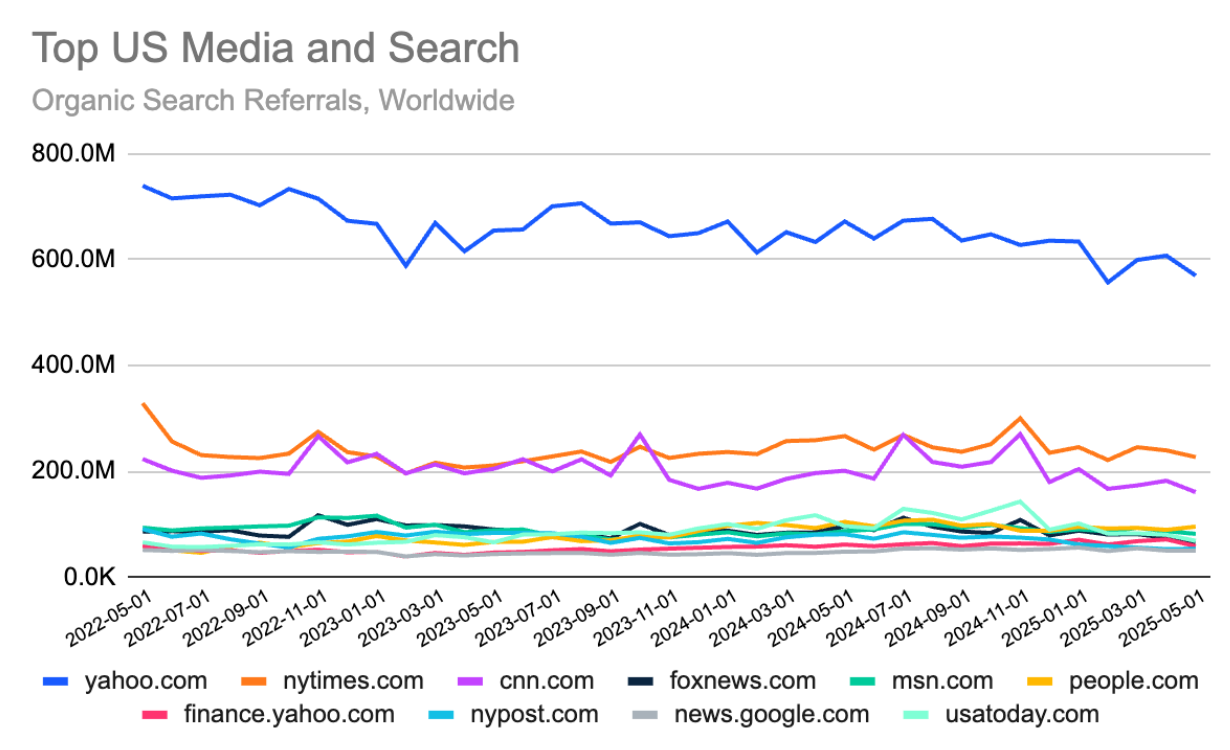
Zero-click behavior continues rising as search engines display more direct answers and AI summaries . Google's AI Overviews appeared in 13.14% of U.S. desktop searches in March 2025, up from 6.49% in January [15]. Since the U.S. launch of Google's AI Overviews in May 2024, the number of searches for news that result in no click-throughs to news websites has grown from 56% to nearly 69% by May 2025 [16].
Users click result links nowhere near as often at the time an AI summary appears. Pew Research Center found that users are less likely to click at the time AI summaries appear in Google Search results [15]. The effect hits harder for major publishers. Analysis showed 75% of the top 100 search keywords driving traffic to CBS News that triggered AI Overviews resulted in no click-throughs to the site in May 2025, compared to 54% of searches with no click-throughs at the time looking at the site's top 100 search terms overall . That's a 21 percentage point difference . Yahoo News had a 20 percentage point difference with 75.1% of AI Overviews keywords triggering no click-throughs , while Substack saw a 17 percentage point difference [16].
Organic search referral traffic has declined from over 2.3 billion U.S. visits in July 2024 to 1.8 billion in June 2025 [16]. Bain's survey estimates this reduces organic web traffic by 15% to 25% . As organic clickthrough rates fall, marketers are losing share of voice in high-value, non-branded searches during the original discovery phase where people seek answers before committing to specific brands [13].
Brand Citations Replace Backlinks as Main Authority Signal
The move from building links to earning mentions represents a fundamental change in off-page optimization strategy . Brand mentions associate 3x more strongly with AI visibility than backlinks [17]. An analysis found that brand mentions had a stronger correlation (0.664) with AI visibility than backlinks (0.218), showing that being talked about now matters more than being linked [18].
AirOps research shows that 85% of brand mentions in early-stage discovery queries come from third-party sources, suggesting that external validation plays a larger role in visibility than owned content alone . Brands with strong authority signals are up to 3x more likely to be cited in AI-generated answers and featured snippets [19]. AirOps found that brands achieving both mention and citation signals are 40% more likely to resurface in consecutive AI responses, while single-signal presence is unpredictable [17].
Authority signals are the digital proof points that demonstrate your brand is a trusted, credible source of knowledge . Without digital proof of expertise, AI won't risk presenting your brand in its answers [20]. Brand authority signals help AI systems decide which sources are credible enough to reference at the time generating answers . Signals like third-party mentions, authoritative backlinks, consistent expert citations, and positive sentiment indicate that a brand is trusted beyond its own site [19].
Research from Yext analyzing 6.8 million AI citations across ChatGPT, Gemini, and Perplexity shows that 86% of citations come from sources brands already control, such as websites and listings [21]. Websites generated 2.9 million citations (44%), ahead of listings at 2.9 million (42%) and reviews/social at 545,000 (8%) . Forums like Reddit factored in for just 2% of citations once location context and query intent were applied [21].
Citation patterns vary by question type. First-party websites and local pages made up nearly 60% of citations for unbranded objective queries . Branded or subjective queries leaned more heavily on listings and reviews . AI models show distinct priorities: Gemini favors websites at 52.1%, OpenAI leans on listings at 48.7%, and Perplexity diversifies across MapQuest and TripAdvisor [21].
Fuel Online's 2026 AI SEO report analyzing 1,000 enterprise brands shows that 62% were invisible to generative AI models, despite 94% investing heavily into traditional SEO . Visibility gets you indexed, but confidence is what gets you chosen by AI search systems [22].
AI Visibility Tracking Becomes Essential for Marketing Strategies
Classic SEO metrics measure how well you win clicks; generative search KPIs measure how well you win influence, even at the time users do not click . A zero-click AI Overview that cites your guide on a topic can still shape vendor shortlists and decision criteria, even if no one lands on the page . Your dashboard should treat this as a measurable touchpoint by tying impressions, citations, and sentiment to downstream metrics like demo requests, even at the time attribution is modeled rather than direct [23].
Marketing teams should integrate Google Search Console data with new visibility tracking tools that detect answer appearances and monitor brand mentions in AI summaries . Many enterprise SEO platforms now include AI visibility modules, allowing marketers to see at the time and where their content is surfaced in generative search results . Reports should evolve beyond leading with traffic or clicks to focus on visibility within high-value queries, accuracy of representation, and sentiment tied to cited content [15].
Several new metrics have emerged to track AI visibility performance:
Answer inclusion rate tracks how often a brand's content appears inside AI-generated answers or summaries, suggesting the depth of authority and how often algorithms rely on your material at the time forming responses [15].
Entity presence index measures how consistently your brand, product, or leadership is recognized across AI and search environments, reflecting how clearly both algorithms and audiences associate you with defined areas of expertise [15].
Source authority score assesses the trust and quality of your content by blending accuracy, structure, and freshness, meaning your material is regarded as credible at the time engines compile answers [15].
AI citation frequency counts the number of times your content is quoted or linked within AI-driven responses on platforms such as Google, Bing, or Perplexity, showing that your insights shape how information is presented across digital channels actively [15].
Brand Mention Rate (BMR) measures how often your brand appears at the time AI engines respond to relevant queries . The formula is: BMR = (Brand Citations ÷ Total Results Sampled) × 100 . If you sample 500 AI responses across target queries and your brand appears in 75 of them, your BMR is 15% [21].
Recommendation Rate (RR) tracks how often AI engines recommend your brand actively at the time users ask for suggestions . The formula is: RR = (Brand Recommendations ÷ Total Recommendation Opportunities) × 100 . If your brand appears in 40 of 200 queries that trigger recommendation lists, your RR is 20% [21].
Share of voice in AI contexts measures your brand's visibility relative to competitors . AI SOV = (Your Brand Mentions ÷ Total Category Mentions) × 100 . If AI engines mention brands 300 times total and your brand factors in for 90 mentions, your SOV is 30% [21].
Talkwalker research shows that 36% of generative AI users have already replaced traditional search engines with AI assistants, and one in four use them for shopping and price comparisons . Authoritas research shows that click-through rates can fall by up to 80% on some queries at the time AI summaries appear in Google search results [21].
AI visibility tracking monitors how AI platforms like ChatGPT, Claude, Perplexity, and Gemini mention, cite, and recommend your brand . With 7 billion monthly AI visits and growing, tracking brand mentions and citations in AI responses is essential for awareness, traffic, and revenue [24]. 314 million people used AI daily in 2024, not just for chatting but to look up products, reviews, and brands [25].
Top Brands Capture 47% of All AI Citations in Their Industries
Citation studies tracked across nine verticals and seven major AI platforms reveal no universal top source . Citation patterns vary widely by platform, industry, and intent . Tinuiti's Q1 2026 AI Citation Trends Report tracked high commercial-intent prompts across ChatGPT, Perplexity, Google AI Mode, Google AI Overviews, Google Gemini, Microsoft Copilot, and Meta AI over four months ending in January 2026 [26].
By January, Google AI Mode was citing 143% more unique domains than AI Overviews, a gap that barely existed two months earlier . The surfaces are evolving at different speeds, in different directions, with different source priorities . BrightEdge shows that roughly 17% of AI Overview citations overlap with Page 1 organic rankings, and that share varies substantially by industry [26].
AirOps documented that only 30% of brands stay visible across consecutive answers . Inconsistent appearance, even at the time occasionally mentioned, suggests weak brand signals that need strengthening [17]. Industry differences show retail relies on owned websites, with 47.6% of citations coming from first-party websites . Finance favors authoritative domains, with 48.2% of citations tied to brand-owned websites like local banking pages [21].
The competitive edge now lies in citation rather than traffic . Organizations that invest in visibility, accuracy, and trust will lead the next wave of digital growth [15]. Yext's companion report, The Rise of AI Search Archetypes, found that over half of U.S. consumers now use AI assistants weekly . Yet 64% of marketing leaders remain uncertain how to measure AI search success, and 72% believe AI search will overtake traditional SEO within three years [27].
AI visibility measurement requires three main metrics working together . Brand mention presence shows how often each tracked brand appears in AI responses, including the number of results, mention rate, and share of voice . Competitive comparison patterns show how AI groups and ranks brands in your category, revealing who you are compared to and how you are distinguished . At the time someone asks for the best tools in your space, AI provides a shortlist with brief summaries typically, and the order of brands, language used, and reasons given for inclusion all shape perception [21].
Shift 3: AEO / GEO Investment Becomes Standard Practice for CMOs
AEO / GEO Investment Becomes Standard Practice for CMOs
Executive leadership has moved past the experimental phase of Answer Engine Optimization. Budget allocations now reflect a strategic move as marketing leaders recognize that AI-mediated discovery determines competitive positioning across digital channels.
98% of CMOs Now Investing in AEO / GEO
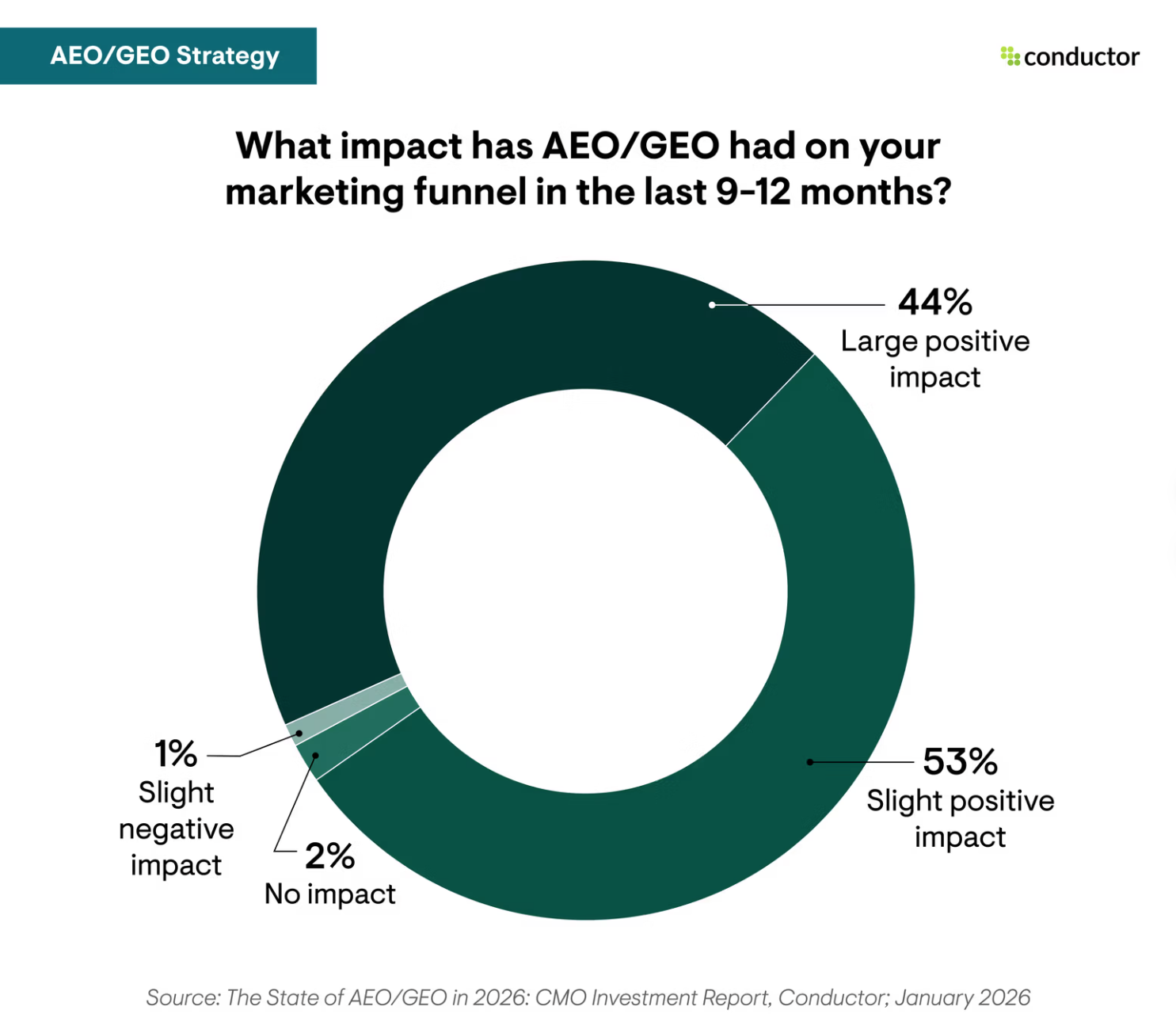
Source:conductor
Investment in AEO / GEO has reached near-universal adoption among enterprise marketing leaders. Research tracking CMO spending patterns found that 97% reported positive effects from AEO / GEO in 2025 . An overwhelming 94% plan to increase their AEO / GEO investments in 2026 [28].
Current investment levels show major commitment. 56% of CMOs and digital leaders made major or high investment in AEO / GEO in 2025 . Enterprises now allocate an average of 12% of their digital budgets to AEO / GEO initiatives [28]. This percentage represents a fundamental reallocation of resources away from traditional SEO and paid search toward AEO / GEO-focused strategies, tools and agencies [29].
Organizational maturity determines tooling sophistication. Among surveyed leaders, 51% use a fully integrated AEO / GEO platform . Organizations with high AEO / GEO maturity are nearly 6x more likely to use a fully integrated platform than low-maturity organizations [28]. This gap suggests that early adopters have already moved beyond point solutions toward unified systems that measure and optimize brand presence across AI platforms at scale.
Confidence in these investments runs high. Among marketing leaders, 97% confirmed that AEO / GEO delivered positive effects in 2025 [30]. But 64% of marketing leaders remain uncertain how to measure AI search success , while 72% believe AI search will overtake traditional SEO within three years [31].
AEO / GEO Tool Spending Surges 340% Year-Over-Year
The AEO / GEO services market has entered explosive growth. The global AEO / GEO market reached USD 762.5 million in 2024 and is projected to register a revenue CAGR of 30.1% during the forecast period [29]. Other projections show the market valued at USD 1.01 billion in 2025, growing to USD 1.48 billion in 2026, and reaching USD 17.02 billion by 2034 at a CAGR of 45.5% [31].
Regional markets show varying adoption curves. The U.S. AEO / GEO market is projected to reach USD 365.4 million in 2026 at a CAGR of 42.9% . Europe's market is estimated at USD 243.8 million in 2026, predicted to reach USD 2,775.1 million by 2034 at a CAGR of 35.5% . Europe's leadership stems from strong regulatory emphasis on digital sovereignty and AI ethics [32].
Traditional SEO tools have integrated AI-specific features faster. A growing set of AI-SEO vendors emerged in 2024-2025 and offered tooling for content scoring, summary-readiness and schema automation . Many traditional SEO tools added AI features including automated topic clusters, content scoring and answer extraction . Companies now use combined toolchains with crawl data and LLM prompts to prioritize content for generative answer optimization [29].
New KPIs have emerged to track this progress. Teams measure AI citation share, overview visibility and zero-click displacement rate more often . Teams track click yield from pages cited by AI Overviews separately from regular organic CTR [29].
Content Optimization Moves to Multi-Platform AI Search
Marketing strategies have evolved to address citation chances across multiple AI platforms at once. ChatGPT serves 800 million users each week , while Google's AI Overviews reach 2 billion monthly users . Perplexity processed 780 million queries in a single month [33]. This fragmentation needs optimization across platforms with different citation priorities and content requirements.
LLMs cite just 2-7 domains per response on average, far fewer than the 10 blue links in traditional search . Competition for AI visibility has become fierce. But brands that optimize well see dramatic results. Pages that include original data tables earn 4.1x more AI citations . Adding specific statistics boosts citation performance by more than 5.5% compared to using single optimization tactics alone [33].
Multi-modal content optimization has become essential. AEO / GEO engagement is 2x higher for multi-modal content combining text and images in 2025 [34]. AI engines pull from multimedia content more often, not just text [35]. Brands must optimize text, image and video assets to be AI-readable, citation-friendly and structured for how large language models interpret content [33].
Tracking AI referrals presents technical challenges. AI referrals often appear as direct traffic in analytics, meaning many brands underestimate their AI visibility . Setting up GA4 custom events and Looker Studio dashboards allows teams to identify traffic from AI engines like ChatGPT and Perplexity, track engagement time and conversion behavior, and compare AI-driven traffic against traditional organic search [33].
Structured Data and E-E-A-T Signals Drive AI Citation Rates
Structured data implementation affects AI citation rates across platforms. Proper Article and FAQ schema increases AI citations by 28% [33]. Research shows that 36.6% of search keywords trigger featured snippets derived from schema markup [36]. Schema markup helps AI systems understand what content is, who created it and how each element connects [33].
The effect can be dramatic. Sharp Healthcare saw an 843% increase in clicks within nine months of implementing schema markup [33]. SAP measured traffic from LLMs growing 168% between 2024 and 2025 . LLM-referred visitors to SAP are more engaged and twice as likely to convert [37].
Research testing structured versus unstructured content confirms the value. An experiment provided ChatGPT with similar content on structured pages versus unstructured pages, then asked the same questions of each version . ChatGPT responses using structured pages scored 30% higher for accuracy, completeness and presentation quality than their unstructured counterparts [37].
Google's E-E-A-T framework—experience, expertise, authoritativeness and trustworthiness—remains critical for AEO / GEO [33]. Brands with strong E-E-A-T signals are 3x more likely to be cited in AI-generated answers . Brands that prioritize structured content are 40% more likely to be cited by AI . Investing in original data can gain between 30-40% higher AI visibility [37].
E-E-A-T applies across all content formats. Marketers must add author bylines and credentials for articles, use reputable external links in text content, include original photos or videos to demonstrate credibility and keep content updated and accurate [33]. Content with strong E-E-A-T signals may exhibit less volatility during core algorithm updates [36].
ROI Metrics Show Medium Investment Delivers Highest Returns
Measuring AEO / GEO ROI presents distinct challenges compared to traditional marketing channels. AEO / GEO costs range from USD 5,000 to USD 20,000 monthly for mid-sized firms covering content, tools and audits, but returns can be 3-5x when executed well . A 2025 SEMrush study shows AEO / GEO-optimized brands see 35% more AI mentions, leading to 20% higher lead quality [34].
The uncomfortable truth is that needing traditional ROI from AEO / GEO misunderstands the channel . The better question is: what's the chance cost of ceding territory to competitors across multiple AI search tools ? Recent data shows that over 53% of people start their searches with AI assistants at least once a day [38].
Early conversion data shows mixed results depending on measurement approach. AEO / GEO drives 15-20% of conversions in B2B tech according to Gartner as of June 2025 [34]. The U.S. Department of Commerce projects that generative AI optimization can reduce customer acquisition costs by up to 30% and improve content discoverability by up to 45% [32].
Attribution modeling needs new approaches. Traditional last-click attribution models miss the major brand awareness and consideration influence that AI search citations provide throughout extended customer trips . Teams should track organic brand search volume increases following major AI search citations, as users often search for brands after discovering them through AI responses [39].
The strongest argument for AEO / GEO investment is competitive risk. Competitors who establish presence now become default recommendations . They own the narrative in discussions that matter. By the time absence shows up in win/loss analysis, competitors will have spent months or years building positioning advantages that are hard to overcome . AEO / GEO represents infrastructure investment required to compete in an AI-mediated research environment, similar to how companies invest in CRM systems before proving direct revenue effect [38].
Conclusion
These three moves prove that AI search optimization has gone past experimental status into essential marketing infrastructure. With 93% of AI searches ending without clicks, we must measure success through citations and brand mentions rather than traditional traffic metrics.
Brands that optimize for multi-platform AI visibility now hold the competitive advantage. Those who wait risk ceding territory to competitors who are building authority signals and earning citations on ChatGPT, Perplexity and Google AI Overviews.
Audit your current AI visibility, implement structured data and track brand mentions across AI platforms. Brands that act now will define category narratives before competitors establish positioning that becomes difficult to overcome.
Key Takeaways
The SEO landscape is undergoing a fundamental transformation as AI search platforms reshape how brands achieve visibility and drive conversions in 2026.
• AI search traffic has reached critical mass with 25% of Google searches now triggering AI Overviews, while ChatGPT dominates with 87.4% of AI referral traffic and converts visitors at 4.4x higher rates than traditional organic search.
• Zero-click searches are forcing new visibility metrics as 93% of AI search sessions end without website clicks, making brand citations and mentions 3x more valuable than backlinks for establishing authority.
• AEO / GEO investment has become standard practice with 98% of CMOs now investing in it, as tool spending surges 340% year-over-year and structured data implementation increases AI citations by 28%.
• Competitive positioning now depends on multi-platform AI visibility rather than traditional rankings, with top brands capturing 47% of all AI citations in their industries through strategic optimization across ChatGPT, Perplexity, and Google AI.
The window for establishing AI search presence is narrowing rapidly. Brands that audit their current AI visibility, implement structured data, and track citations across platforms today will own category narratives before competitors establish positioning advantages that become nearly impossible to overcome.
References
[1] - https://cxl.com/blog/ai-search-vs-traditional-seo-shift/
[2] - https://insight.kellogg.northwestern.edu/article/as-ai-eats-web-traffic-dont-panic-evolve
[3] - https://seranking.com/blog/ai-statistics/
[4] - https://www.pewresearch.org/short-reads/2025/07/22/google-users-are-less-likely-to-click-on-links-when-an-ai-summary-appears-in-the-results/
[5] - https://www.searchenginejournal.com/google-ai-overviews-appear-on-21-of-searches-new-data/560471/
[6] - https://digiday.com/media/chatgpt-is-now-20-of-walmarts-referral-traffic-while-amazon-wards-off-ai-shopping-agents/
[7] - https://www.wordstream.com/blog/google-ai-overviews-statistics
[8] - https://searchengineland.com/google-ai-overviews-drive-drop-organic-paid-ctr-464212
[9] - https://ahrefs.com/blog/ai-search-traffic-conversions-ahrefs/
[10] - https://www.orbitmedia.com/blog/traditional-search-vs-ai-search/
[11] - https://business.adobe.com/blog/generative-ai-powered-shopping-rises-with-traffic-to-retail-sites
[12] - https://searchengineland.com/llms-google-referral-conversion-study-463747
[13] - https://www.bain.com/insights/goodbye-clicks-hello-ai-zero-click-search-redefines-marketing/
[14] - https://bristolcreativeindustries.com/ultimate-guide-to-zero-click-search-adapting-to-the-ai-era/
[15] - https://martech.org/ai-is-rewriting-visibility-in-the-zero-click-search-era/
[16] - https://digiday.com/media/in-graphic-detail-ai-platforms-are-driving-more-traffic-but-not-enough-to-offset-zero-click-search/
[17] - https://www.rankscience.com/blog/ai-citations-brand-mentions-visibility-gap
[18] - https://wellows.com/blog/brand-mentions-vs-citation/
[19] - https://www.airops.com/ai-search-hub/brand-authority-signals
[20] - https://brandauthorityai.com/authority-signals-ai-search/
[21] - https://www.talkwalker.com/blog/track-brand-mentions-in-ai-search
[22] - https://www.thehoth.com/blog/ai-search-trust-signals/
[23] - https://www.singlegrain.com/blog-posts/analytics/ai-visibility-dashboards-tracking-generative-search-metrics-in-real-time/
[24] - https://www.finseo.ai/ai-visibility-tracking
[25] - https://searchengineland.com/guide/how-to-measure-brand-visibility
[26] - https://searchengineland.com/ai-citation-data-no-universal-top-source-brands-471285
[27] - https://martechedge.com/news/ai-citations-report-yext-study-reveals-86-of-ai-generated-sources-are-brand-controlled
[28] - https://www.conductor.com/academy/state-of-aeo-geo-report/
[29] - https://marketingltb.com/blog/statistics/generative-engine-optimization-statistics/
[30] - https://cmscritic.com/in-the-race-to-ai-visibility-are-aeo-and-geo-really-delivering-97-of-digital-leaders-say-yes
[31] - https://www.intelmarketresearch.com/generative-engine-optimization-services-market-36546
[32] - https://dimensionmarketresearch.com/report/generative-engine-optimization-geo-market/
[33] - https://www.getpassionfruit.com/blog/how-to-optimize-for-multimodal-ai-search-text-image-and-video-all-in-one
[34] - https://klickerinc.com/how-to-measure-roi-from-answer-engine-optimization/
[35] - https://blog.hubspot.com/marketing/answer-engine-optimization-trends
[36] - https://blog.clickpointsoftware.com/google-e-e-a-t
[37] - https://digitalmarketinginstitute.com/blog/optimize-content-for-ai-search
[38] - https://foundationinc.co/lab/roi-of-geo
[39] - https://www.getpassionfruit.com/blog/measuring-roi-from-ai-search-engine-optimization-metrics-that-matter-for-geo