GEO vs. SEO: Why Your Brand Needs a Dual Optimization Strategy in 2026?
The geo vs seo conversation is no longer theoretical. AI Overviews now appear in 13.14% of all search queries, doubling from 6.49% in January 2025. 90% of businesses are concerned about SEO's future as AI reshapes how users find information. Here's what we know: SEO remains your foundation for digital visibility, but generative engine optimization (GEO) is now critical for reaching audiences on AI-powered platforms. Your brand needs both. We'll break down the differences between SEO and GEO and show you how to build a dual optimization strategy that works.
What Is SEO and Why It Still Matters
Search engine optimization (SEO) improves website visibility in unpaid search results to attract qualified traffic. SEO has evolved way beyond the reach and influence of simple keyword placement. Modern optimization works with user intent, semantic search patterns, and AI-powered algorithms that reward clarity and authority over shortcuts.
Core Components of Search Engine Optimization
SEO operates on three interconnected pillars. On-page SEO handles content optimization. This includes keyword research, high-quality content creation, meta tags and internal linking structures. Off-page SEO builds authority through backlinks from reputable sources and social engagement signals. Technical SEO makes sure search engines can crawl and index your site through proper architecture, site speed, mobile optimization, schema markup and Core Web Vitals [1].
Keyword research remains the essential foundation. Every other tactic weakens without identifying terms your audience searches and that you can rank for. AI has transformed this process completely. 92% of marketers now rely on measures that account for both traditional and AI-supported search engines. Topic clusters have replaced isolated keyword strategies. They create semantic connections between main topics and subtopics that increase visibility and stimulate organic traffic growth [1].
How Traditional SEO Drives Organic Traffic
The numbers tell a compelling story. Organic search generates 53.3% of all web traffic [2]. The first organic result on Google captures a 39.8% click-through rate. The first paid ad position gets just 2.1% [1]. Users trust organic listings over advertisements.
Organic search produces 300% more traffic than social media. It accounts for over 40% of total revenue across B2B, technology, retail and hospitality sectors. Nearly half of all marketers report that organic SEO delivers the highest ROI compared to other digital channels [1]. Paid campaigns stop generating traffic the moment spending ends. Well-optimized content continues attracting visitors for months or years without ongoing ad costs [2].
SEO as the Foundation for Digital Visibility
SEO matters more in 2026 because the bar has risen. Google still drives the majority of purchase-intent traffic. AI tools require structured, high-quality website content to generate recommendations [3]. If your content lacks clarity or depth, AI platforms will reference your competitors instead.
Building strong SEO creates durability. Sites with solid authority, clean structure and helpful content weather algorithm updates better than those relying on shortcuts [3]. Local SEO has grown in importance. Over 1.5 billion monthly searches include "near me" modifiers, and 28% of those searches lead to purchases [1].
Understanding geo vs seo becomes critical here. SEO establishes your foundational visibility and credibility. Generative engine optimization (GEO) builds on this foundation to make sure AI-powered platforms cite and recommend your brand. You cannot succeed with GEO without first becoming skilled at traditional SEO fundamentals [3].
What Is GEO and How It Works
Generative engine optimization (GEO) is the practice of positioning your brand and content so AI platforms cite, recommend, or mention you when users search for answers [2]. The difference between geo vs seo becomes clear when you get into the end goal. Traditional SEO wants to rank your page in search results. GEO will give your content the status of being the source AI systems quote when generating responses [1].
Understanding Generative Engine Optimization
AI search operates fundamentally differently than keyword-based search. AI search engines use large language models to understand query meaning and generate direct answers by combining information from multiple sources instead of returning ranked lists of links [4]. ChatGPT reached 800 million weekly users, while Google's Gemini app surpassed 750 million monthly users [2]. ChatGPT and Perplexity now represent the second most common source of qualified B2B leads at 34%, trailing only social media at 46% [4].
The competitive reality is stark. LLMs cite just 2-7 domains per response on average [5], nowhere near traditional search's multiple result pages. Between 40% and 60% of cited sources change from month to month [2], creating volatility that just needs constant monitoring. Only 11% of domain citations overlap between ChatGPT and Perplexity [6], meaning platform-specific optimization becomes critical.
How AI Search Engines Process Content
AI search engines follow a five-step Retrieval-Augmented Generation (RAG) process. The system first interprets user intent and context. It then retrieves relevant sources from web indexes and databases. Next, it assesses these sources for authority, accuracy, recency and relevance. The LLM combines a coherent answer from retrieved sources. Finally, it attributes sources through citations [4].
Content visibility becomes a two-stage process. Your content must first be retrieved as a candidate source, then selected for citation in the generated response. Research shows that 86% of AI citations come from sources brands already control [4], giving you most important opportunities through owned properties. Pages containing quotes and statistics demonstrate 30-40% higher visibility in AI responses compared to content without them [1].
Key Platforms Where GEO Applies: ChatGPT, Perplexity, and AI Overviews
Each platform operates with distinct characteristics. ChatGPT draws from web data using GPTbot and browsing integrations, prioritizing high-authority and frequently updated content. Perplexity integrates live web search into responses, favoring recency and semantic alignment with prominent URL citations for transparency. Google AI Overviews pull from top-ranked search results using Gemini models, selectively triggering for broad topics and trusted domains [7]. These platforms use different source logic and citation behaviors, so successful GEO requires tailored approaches for each.
SEO vs GEO: 6 Critical Differences You Need to Know
To grasp the difference between GEO and SEO, you need to scrutinize six fundamental differences that shape how each strategy operates and delivers results.
Target Platforms: Traditional Search vs AI-Powered Engines
SEO targets traditional search engines like Google and Bing that display ranked lists of web pages [8]. GEO focuses on AI-powered platforms like ChatGPT, Perplexity, Google AI Overviews and Microsoft Copilot that generate combined responses [3]. The platform difference determines everything else about your optimization approach.
Content Presentation: Link Lists vs Combined Answers
Traditional search presents multiple result options. Google offers up to 10 links on the first page and millions more thereafter. AI search engines perform the work of reviewing different sources and deliver one multimodal result that summarizes information without asking users to scan multiple links [3]. SEO wants to get users clicking through to your site. GEO positions your content to be included within the AI-generated answer itself [8].
Ranking Factors: Keywords and Backlinks vs Clarity and Citations
SEO success depends on keyword optimization, backlink profiles from reputable sites, domain authority, site speed and mobile friendliness [8]. GEO prioritizes conversational clarity, factual precision, structured data like schema markup and direct answers backed by reputable sources [3]. Traditional search assesses hundreds of ranking signals to create deterministic results. AI systems interpret intent behind questions and generate unique combined answers by pulling information from multiple trusted sources [9].
User Behavior: Click-Through Traffic vs Zero-Click Consumption
SEO guides users toward clicking through to websites. Success gets measured by whether users reach your site and complete desired actions. GEO satisfies user intent immediately within the conversation and delivers direct answers without asking for site visits [9]. Research shows 80% of consumers rely on zero-click answers for at least 40% of their searches [10]. AI Overviews reduce click-through rates by 15-35% [11] and fundamentally change traffic patterns.
Measurement Metrics: Rankings and CTR vs Citations and Mentions
SEO tracks organic traffic, keyword rankings, click-through rates, bounce rates and conversions from search. GEO measures citation frequency in AI tools, brand mentions in AI answers and share of voice in AI platforms [8]. Traditional metrics assume users discover information by clicking links [2]. GEO metrics measure influence and authority within AI outputs and shift focus from clicks to citations [12].
Content Lifespan: Evergreen Rankings vs Real-Time Relevance
Well-optimized evergreen content can maintain SEO rankings for years with minimal updates. GEO demands content stay fresh and authoritative to remain cited. AI models prioritize recency even more than traditional search [8]. 40% and 60% of cited sources change from month to month and create volatility that requires constant monitoring.
More Comparison
| Aspect | SEO (Search Engine Optimization) | GEO (Generative Engine Optimization) |
|---|---|---|
| Definition | Process of improving website visibility in unpaid search results to attract qualified traffic | Practice of positioning your brand and content so AI platforms cite, recommend, or mention you when users search for answers |
| Main Goal | Rank your page in search results and drive click-through traffic | Ensure your content becomes the source AI systems quote when they generate responses |
| Target Platforms | Traditional search engines like Google and Bing that display ranked lists of web pages | AI-powered platforms including ChatGPT, Perplexity, Google AI Overviews, and Microsoft Copilot |
| Content Presentation | Multiple result options (up to 10 links on first page, millions more thereafter) | One multimodal blended answer that summarizes information without requiring users to scan multiple links |
| Ranking Factors | Keyword optimization, backlink profiles from reputable sites, domain authority, site speed, mobile friendliness (hundreds of ranking signals) | Conversational clarity, factual precision, structured data like schema markup, direct answers backed by reputable sources |
| User Behavior | Takes users to websites through clicks; success measured by site visits and completed actions | Satisfies user intent within the conversation immediately; delivers direct answers without requiring site visits (80% of consumers rely on zero-click answers for at least 40% of searches) |
| Measurement Metrics | Organic traffic, keyword rankings, click-through rates, bounce rates, conversions from search | Citation frequency in AI tools, brand mentions in AI answers, share of voice across AI platforms |
| Content Lifespan | Well-optimized evergreen content can maintain rankings for years with minimal updates | Content must stay fresh and authoritative; 40-60% of cited sources change from month to month |
| Traffic Generation | Gets 53.3% of all web traffic; produces 300% more traffic than social media | Traffic from AI sources to retailer websites rose 1,200% between July 2024 and February 2025 |
| Citation/Visibility | First organic result captures 39.8% click-through rate | LLMs cite just 2-7 domains per response on average; 86% of AI citations come from sources brands already control |
| Core Components | On-page SEO (keywords, content, meta tags), Off-page SEO (backlinks, social signals), Technical SEO (site architecture, speed, mobile optimization) | Conversational content structure, factual accuracy, schema markup, direct question-and-answer format, live relevance |
| Current Adoption | Practice that's decades old; nearly half of marketers report organic SEO delivers highest ROI | Emerging practice; only 37% of marketers optimize content for AI search currently (as of 2026) |
| Market Presence | AI Overviews appear in 13.14% of all search queries (doubled from 6.49% in January 2025) | ChatGPT: 800 million weekly users; Google Gemini: 750+ million monthly users; ChatGPT and Perplexity represent 34% of qualified B2B leads |
Why Your Brand Needs Both SEO and GEO in 2026
Brands that become skilled at both optimization approaches gain visibility across the entire discovery trip. The geo vs seo debate misses the point because consumer behavior just needs dual presence.
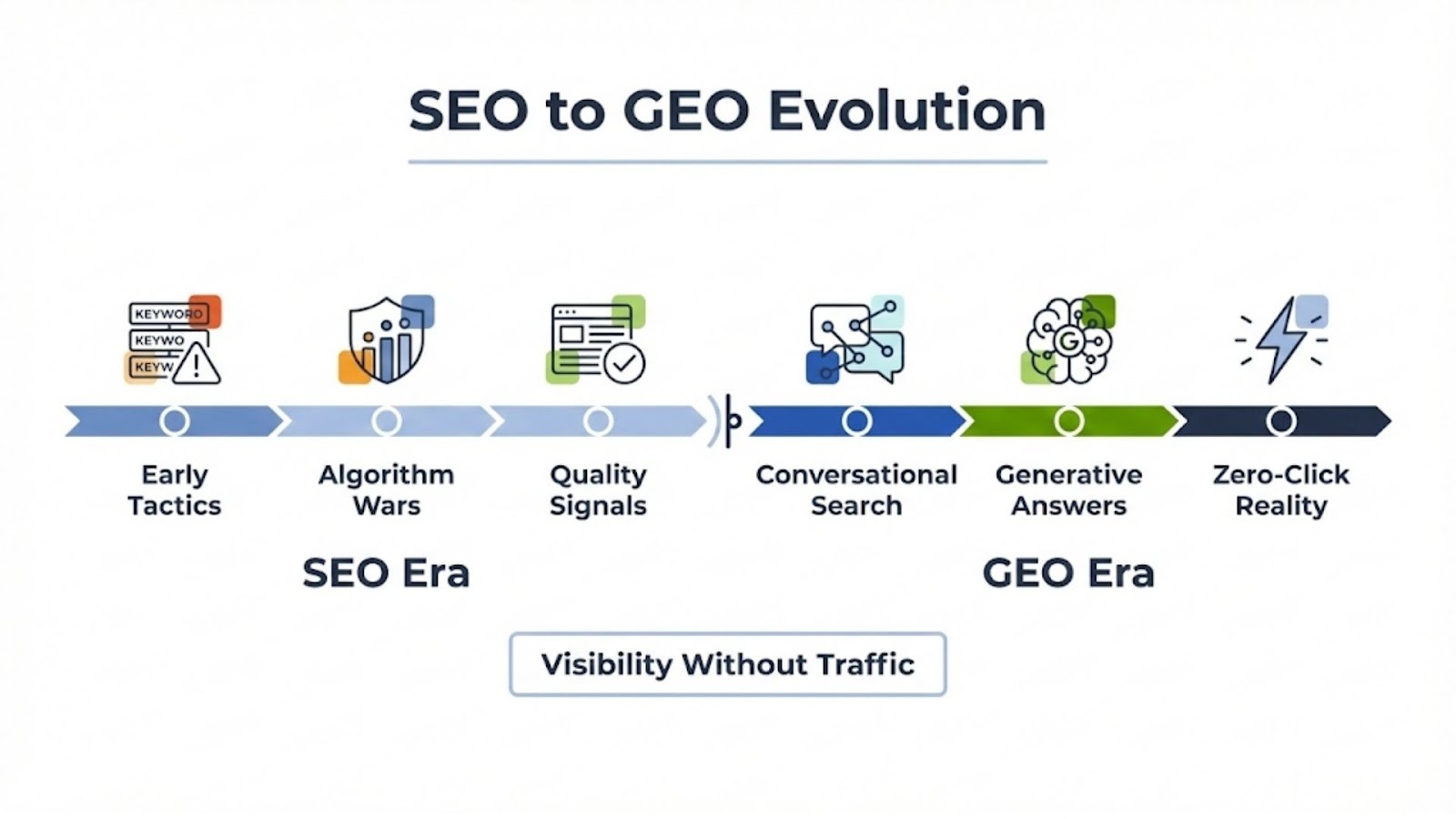
source:riseopp
The Rise of AI Search Is Changing User Behavior
Nearly 60% of U.S. consumers have used generative AI tools for help with online shopping [13]. Furthermore, 72% now use large language models [4], marking a fundamental move in how people research products and services. The traffic AI sources drive to retailer websites rose 1,200% between July 2024 and February 2025 and grew 3,300% year over year during Amazon's Prime Day event [4].
18% say generative AI is a top tool for purchase recommendations, ranking behind only physical stores and ahead of social media. Users find conversational interfaces easier than traditional keyword search. They ask "What should I wear to my son's wedding in July in California?" rather than typing "maxi dress blue" [4]. Target reports guests are adapting by using longer queries and being more conversational even on traditional search functions [13].
SEO Gets You Found, GEO Gets You Recommended
Traditional SEO gets your content listed among options. GEO gets your content recommended as the answer. Users search Google for "best cordless screwdriver under $100" and see a list of products. They ask ChatGPT the same question and it provides specific recommendations, not just options [8]. The difference matters because these channels serve different stages of the prospect trip [14].
Ranjeet Bhosale, VP of digital product management at Target, stated that "the future of SEO is to come into GEO". Most Target customers still use traditional one-keyword, two-keyword-based search. Nino from Every Man Jack confirmed that 30-40% of traffic comes from SEO [13]. This proves traditional search remains vital while AI platforms grow.
Building Trust Across All Search Touchpoints
Users see all brand experiences as one continuous trip. The same narrative reinforced across multiple high-visibility channels increases the chances that AI models represent your brand accurately [15]. Brands not keeping an eye on the GEO space will miss out [13]. Those ignoring SEO fundamentals lack the foundation AI engines need to understand their content [16].
The Competitive Advantage of Early GEO Adoption
First movers gain competitive advantage [15]. GEO adoption creates a compounding authority advantage because the more you're cited, the more generative engines recommend you [14]. Brands that fail to adapt risk becoming invisible to a growing segment of their target audience [7]. So, only 37% of marketers optimize content for AI search [17]. This creates a massive chance for early adopters to establish market position before competitors catch up.
How to Build a Dual Optimization Strategy
You need methodical execution in five critical areas to build a geo vs seo strategy that works.
Start With Strong SEO Fundamentals
Strong SEO creates the prerequisite for effective GEO performance [6]. Your site needs clean technical performance, smart keyword targeting and high-quality content that shows topical authority [18]. Content should be organized into topic clusters with a pillar page that provides broad overview and supporting cluster pages covering related subtopics. Strategic internal linking boosts site structure and crawlability for SEO. It also establishes semantic relationships that AI systems use to understand content [1].
Monitor Your Visibility on Traditional and AI Platforms
AI visibility platforms query AI engines with thousands of industry-related questions and track when and how your brand appears in responses. They analyze whether you're the recommended solution or just mentioned in passing. You lack visibility into whether high-value content is even available to AI engines you're optimizing for without dedicated monitoring. Track citations and brand mentions on ChatGPT, Perplexity, Google AI Overviews and other leading LLMs [19].
Add Structured Data and Schema Markup
Schema markup helps AI systems understand content meaning and context. FAQ, HowTo and Article schema types provide complete context [20]. Layer multiple schema types when relevant so AI systems confidently cite your content rather than skip over it [5].
Optimize Content Structure for AI Readability
AI systems interpret natural, question-based inputs better than traditional keyword searches. Content should be structured around real questions users ask [18]. Clear H2 and H3 hierarchies, bullet points, numbered lists and tables help AI tools parse and prioritize information. Plain language in conversational tone simplifies complex concepts [20].
Integrate SEO and GEO Into One Unified Approach
Map keywords to common user questions and intents. Then structure content to answer those questions with natural language and direct responses [1]. Presence should expand to forums, social platforms and multimedia channels. This distribution helps search everywhere optimization efforts and gives AI engines more chances to surface your brand. SEO helps content get found while GEO helps it get included in answers. So executing both together maximizes visibility on traditional search and AI-driven platforms [18].
Key Insight
SEO are the foundations of GEO. You cannot succeed with GEO without first mastering traditional SEO fundamentals. Strong SEO creates the prerequisite for GEO to work, as AI tools need structured, high-quality website content to generate recommendations. The competitive landscape in 2026 just needs businesses to build on their SEO efforts and further optimize for GEO. This creates a dual optimization strategy that maximizes visibility across both traditional search and AI-driven platforms.
Conclusion
The geo vs seo debate misses the point: your brand needs both strategies working together. SEO remains your foundation and drives 53.3% of web traffic. It establishes the authority that AI platforms require. GEO builds on this base and ensures AI systems cite your content when they answer user questions.
Brands that excel at both get visibility across the entire discovery path. Early adopters are establishing competitive advantages while 63% of marketers haven't optimized to AI search yet. The window remains open, but it's closing fast. Build strong SEO first and then layer GEO optimization on top for complete search visibility.
References
[1] - https://cmdagency.com/blog/seo-to-geo-unified-content-strategy
[2] - https://riseopp.com/blog/geo-vs-seo-the-guide-to-rankings-and-ai-citations
[3] - https://www.seo.com/ai/geo-vs-seo/
[5] - https://www.conductor.com/academy/unified-aeo-geo-seo/
[8] - https://www.semrush.com/blog/geo-vs-seo/
[9] - https://www.informatechtarget.com/blog/geo-vs-seo-a-marketers-guide-to-dual-optimization/
[11] - https://www.razorfish.com/articles/perspectives/zero-click-search-reframing-search-in-the-age-of-ai/
[12] - https://eseospace.com/blog/key-geo-ranking-factors-explained/
[13] - https://digiday.com/marketing/how-brands-and-retailers-are-preparing-for-geo-the-future-of-seo/
[14] - https://attorneyatlawmagazine.com/legal-marketing/is-geo-the-new-seo-for-law-firms
[15] - https://deloitte.wsj.com/cmo/seo-to-geo-strategies-for-marketers-ad77f61f
[16] - https://www.vortexsolution.com/en/blog/why-seo-remains-essential-in-a-geo-world/
[17] - https://martech.org/6-things-marketers-need-to-know-about-search-and-discovery-in-2026/
[18] - https://neilpatel.com/blog/geo-vs-seo/
[19] - https://www.conductor.com/academy/best-ai-visibility-platforms/
[20] - https://www.techtarget.com/searchcontentmanagement/tip/How-to-integrate-GEO-with-an-SEO-strategy