How Overseas Brands Can Claim Their Niche with GEO in the AI Era | Innflows at GTLC Hangzhou

How Overseas Brands Can Claim Their Niche with GEO in the AI Era
When users stop "searching" and start "asking," the entry point to traffic is being rewritten.
The next battleground for overseas brands isn't the shelf, it's the AI's answer.
A Conversation About the "New Decade"
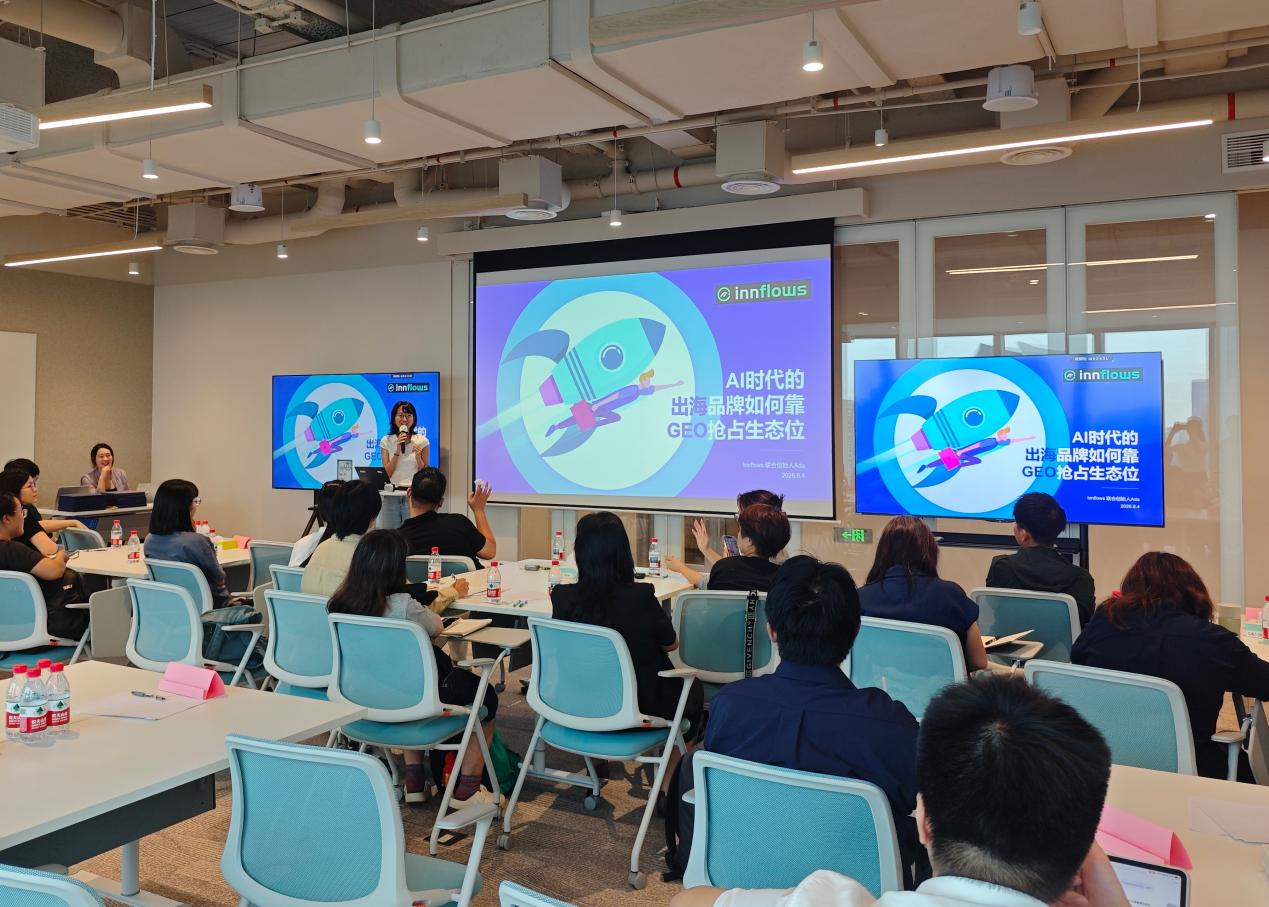
The TGO Networks GTLC (Global Technology Leadership Conference) Hangzhou stop was recently held. Themed "A New Decade: Let's Do What AI Does," this edition focused on two core directions, harness engineering and Agents reshaping enterprise business, with in-depth discussions across AI coding, startup practice, and product operations. The room was packed with technically minded founders and enterprise tech leaders.
In a setting with such high "technical density," Innflows co-founder Ada (Wang Xiayi) brought a slightly different angle. Rather than starting from model architecture, she opened with a first-principles business and marketing question: In the AI era, how can overseas brands claim their niche with GEO?
Ada spent years inside the Amazon programmatic advertising ecosystem, leading commercial operations at a top overseas-marketing agency, where she personally covered up to USD 18 million in annual business at peak and served numerous leading export brands. She also brings an equity-financing (FA) background that connects founders with investors. It's exactly this blended lens, fluent in marketing, business, and the practical landing of frontier tech, that made the talk both strategically deep and grounded.
Two Decades of Going Global: From "Goods to the World" to "Brands to the World"
To understand why GEO is the opportunity of the moment, you first have to see the road that brought us here. Ada divides the 20-plus years of retail going-global into three phases:
Phase 1 · Goods to the World (1999–2012). The B2B digitalization era led by Alibaba, powered by price gaps, information gaps, and supply-chain sourcing. If you had a factory and low-cost products, you could earn a margin overseas and ride the wave.
Phase 2 · Efficiency Wins (2013–2019). Amazon's global-store push sent Chinese sellers into a boom. The B2C market scale tripled in two years from roughly RMB 30 billion. This phase was a contest of selection efficiency, traffic efficiency, and operational efficiency, the reason South China sellers excelled was precisely how fiercely competitive they were.
Phase 3 · Brands to the World (today). Competition has leveled up from on-platform operations to full-channel integration: online and offline, every sales and marketing channel, localized presence, and most critically, whether you can become a brand that earns repeat purchases overseas rather than selling just once.
The numbers are convincing: in 2025, China's export cross-border e-commerce reached RMB 2.27 trillion, with over 759,000 affiliated enterprises (a conservative count; factoring in the independent-site ecosystem, the real number of entities could reach millions). Anker grew its revenue roughly 23x between 2015 and 2025.
But the growth curve is flattening: Phase 2's compound annual growth rate once hit around 70%, and it has now dropped to the low teens. With traffic and logistics costs rising across the board and growth slowing, where is the incremental opportunity for overseas brands? That's the question Ada put to the room.
The Question Has Changed: Consumers No Longer "Search for Answers," They "Ask"
Ada offered a sharp judgment: "E-commerce platforms only solve for answers, not for problems."
In the past, a consumer wouldn't ask Amazon or JD "what should I do about itchy skin." They'd first go to content platforms like Xiaohongshu, Reddit, or Zhihu to solve the problem, land on a category answer (say, "I need a body lotion"), and only then return to an e-commerce platform to search the category keyword and buy. This is also why brand margins keep thinning, everyone crowds onto e-commerce platforms fighting for the same core keywords, pushing traffic costs ever higher.
Meanwhile, AI is fundamentally changing the "people-find-goods" scenario:
- Domestic users are getting used to asking Doubao and DeepSeek;
- Overseas users turn to ChatGPT and Gemini;
- On Google, about 25% of searches are now intercepted by AI Overview, users see the answer the model gives and often don't scroll further, purchase decisions included.
A deeper shift is happening on the "goods-find-people" side. Ad targeting used to rely on audience tags, which carry inherent data blind spots and subjective bias. Ada gave a vivid example: few men in the room use tone-up cream, but a particular group of cosplay enthusiasts do, because a full white-base foundation looks too exaggerated, while tone-up cream looks more natural. Or take smart locks: people with long manicured nails are a genuine need-based audience, yet traditional targeting would rarely notice them.
These highly niche, previously hard-to-discover audiences are exactly the ones AI, being "well-read," can reach precisely. When a consumer asks "my base makeup looks unnatural, what do I do," AI may suggest tone-up cream. So the question becomes: if you're a tone-up-cream brand, how do you get AI to surface your brand and category in that scenario?
In the past, we used ads and tags to "find people."
Now, we use content to "match" the intent of potential audiences.
That is the most fundamental logic of GEO.
The Three Core Pillars of GEO: Intent, Content, Channels
Ada breaks GEO (Generative Engine Optimization) into three things you must get right:
- Intent — What kinds of questions will consumers actually ask in the AI environment?
- Content — How do you create content that makes AI trust and index you?
- Channels — Which media should you place content on so AI is more willing to cite you as a source?
Before offering solutions, she candidly named several pain points in the industry today:
- "Ranking first" doesn't equal "performing well." Take Innflows client and high-speed hair-dryer brand Laifen: ranking at the top of "which hair dryer is safest and least damaging" doesn't mean you cover the real intent of most users in the category, and with answers being personalized, asking a question once won't represent the whole picture.
- LLM data is not open. Only the model itself knows how and what consumers actually ask in the AI environment. How a GEO service provider reconstructs this is an industry-wide challenge.
- "Brute-force" content flooding is questionable. Many providers churn out content frantically, chasing volume over quality, whether that approach actually works is dubious.
The Innflows Approach: Use a Proprietary Agent to Turn "Guessing" into "Computing"
For these three pillars, Innflows offers a systematic solution built on a proprietary distilled model and Agents.
Step 1 · The Full-Link Intent Simulation Engine
Unlike traditional SEO that analyzes single keywords, Innflows built a Full-Link Intent Simulation Engine. Powered by a self-built brand and industry knowledge graph, it continuously pulls core data, via APIs and daily crawlers, from sources like the Google Search Index, Reddit / Quora discussions, and competitor whitepapers, covering categories, product lines, product features, competitor audience profiles, and scenario-level VOC. On top of that, it performs three-dimensional modeling:
- The user-journey dimension. Take a 3D printer: a novice asks "what can a 3D printer even do"; a parent with a scenario need asks "is the educational one safe, what about the dust"; near the decision point they ask "is this brand reliable, are there pitfalls" and start comparing. A single "best" keyword can't possibly cover the entire AIPL journey.
- The audience-profile dimension (MBTI-style abstraction). Someone earning RMB 10M a year and someone earning 200K make completely different purchase decisions, different price points, different trust preferences, some lean toward big brands, others chase niche, geeky ones.
- The intent-paradigm dimension. Different questions follow different phrasing paradigms.
From these three dimensions it abstracts Topics, then splinters out a large set of Questions, the engine simulates 10,000+ real users asking questions across major AI platforms, under different intents and different models, capturing brand performance in real time. After logging all citation data in full, it runs semantic, sentence, and citation analysis to output quantified, probabilistic results. Brands can also customize the engine for periodic monitoring aligned to their own content-optimization cycles, uncovering patterns in AI preferences.
Step 2 · The FLOWS Five-Dimension Model to Quantify AI Performance
So how do you measure how well a brand performs in the AI environment? Innflows built the FLOWS Brand Trust Model, an LLM-powered brand-equity evaluation system that distills real-world feedback from the AI industry into a quantifiable "Brand AI Trust Score." It comprises five dimensions:
- FI · Find-ability Index — Frequency of brand mentions in AI responses, position weight, and overall length proportion. Reflects whether the brand can be found.
- LO · Leading Orientation — Degree of recommendation in AI responses, plus informativeness and intent matching. Measures whether AI genuinely adopts your content to recommend you rather than a competitor.
- OV · Origin Verification — The authority, credibility, and traceability coverage of your brand's information sources. Whether you have genuinely authoritative backing rather than talking only about yourself.
- WS · Website Structure — The AI-friendliness of your brand site and content carriers, plus the completeness of technical infrastructure. Reflects the trustworthiness of content construction.
- SI · Spread Index — The brand's spread and distribution across public information environments like search engines and vertical platforms. Reflects reach across the internet at large.
The five dimensions resolve into a single radar chart: a score above 80 is excellent, below 60 triggers a warning. It pinpoints whether the shortfall lies in content (WS) or recommendation (LO) and auto-generates the corresponding fix strategy.
Step 3 · A Content Agent That Produces AI-Preferred Content
Once the gaps are diagnosed, the fix still comes down to content. Behind Innflows sits a content Agent grounded in E-E-A-T and two foundational GEO papers, covering the full content spectrum, from educational explainers to soft features to hard ads and how-to guides, and producing client-ready, deliverable drafts directly.
In Princeton's paper that first proposed the GEO concept, the content AI truly prefers shares these traits: easy to understand, authoritative tone, appropriate technical terminology, fluency, precise citation sources, quotations, and statistics and evidence presented in structured form.
Step 4 · Continuous Monitoring, Not a "One-Shot" Question
Asking once is nowhere near enough. Innflows monitors brand performance across different Topics and different media on a recurring cadence, by day or even by hour, and delivers the raw data, including which media mentioned you and which competitors they mentioned, to clients in fine-grained detail.
The Fundamental Difference from "Brute-Force Solving"
In closing, Ada was direct about how Innflows differs from peers:
Many competitors "ask a few answers once and call it done, then brute-force the problem at scale."
We use a proprietary model and Agents to simulate intent, scientifically revealing your real performance probability in a given category and environment, then target media and content precisely based on the insights.
Behind this is the Innflows vision: to elevate the overseas voice of export brands and help more companies grow into scalable, multinational brands.
Final Thoughts: Tickets for the GEO Voyage Are on Sale
The GEO track has only just begun, and more players will pour in. Who will secure a ticket to this "vast blue ocean" of the AI era?
The answer may lie in the line Ada kept repeating:
Look upward: at the audiences, the scenarios, and the questions above.
As consumers shift from "searching for answers" to "asking AI," the contest for a brand's niche has moved forward, from the shelf to the answer itself. Brands that position for GEO early are writing themselves into AI's "default recommendation."
---
About Innflows
Innflows is a technology platform focused on GEO (Generative Engine Optimization) and AI visibility. Built on proprietary models and Agents, it helps overseas brands understand consumers' real intent in the AI environment, quantify brand performance in AI answers, and produce AI-preferred content, so brands get found, trusted, and recommended across answer engines like ChatGPT, Gemini, Google AI Overview, Claude, DeepSeek, and Qwen.
Want to know how your brand really performs in AI answers? Contact Innflows for an AI visibility audit.