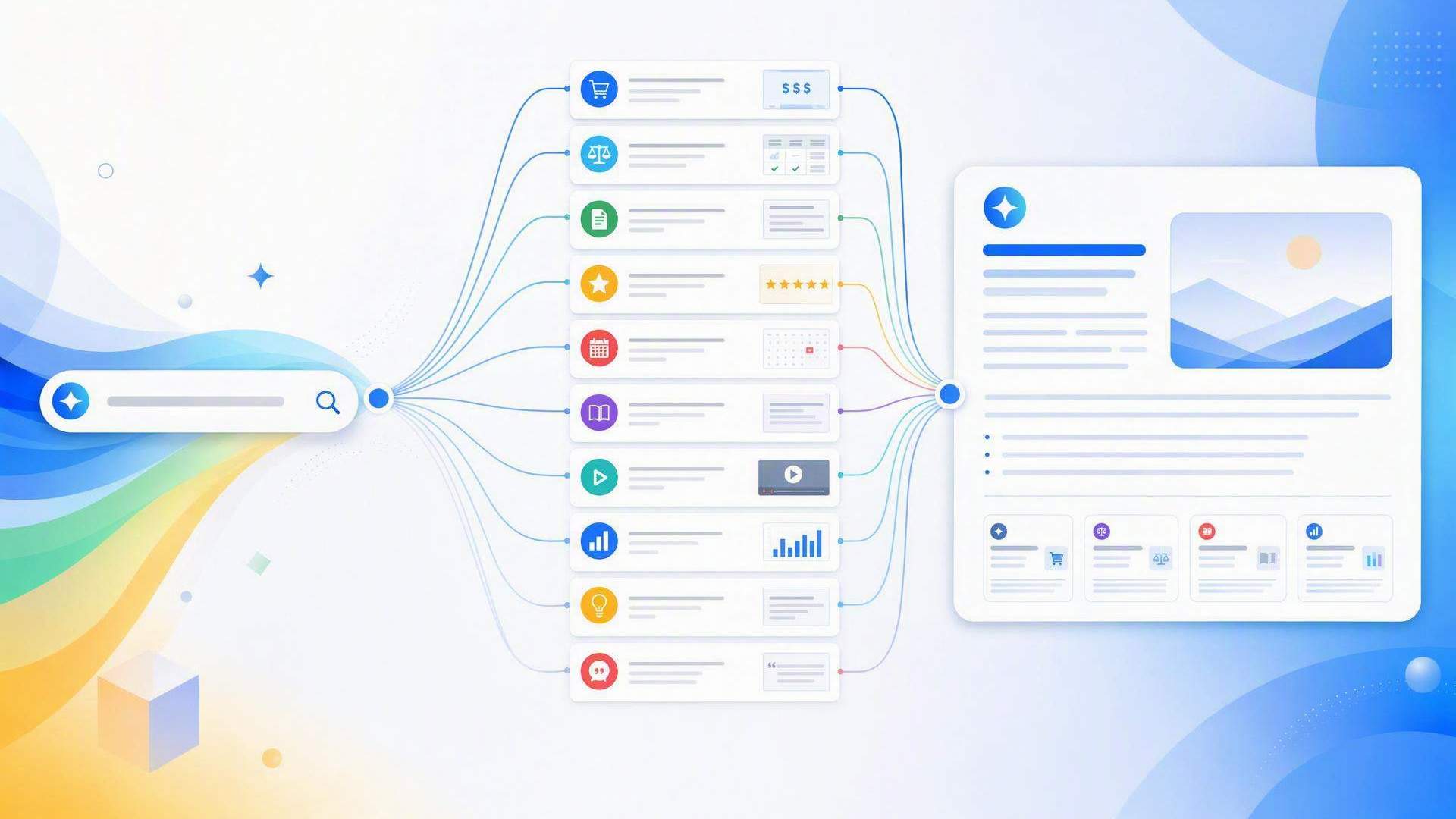
The Dark Matter of AI Citations: Why 60% of Cited Pages Don't Rank on Google
The Dark Matter of AI Citations: Why 60% of Cited Pages Don't Rank on Google
Here is the finding that should reshape how you think about AI search visibility: roughly 60% of the URLs that AI engines cite do not rank in the top 20 organic results on Google or Bing for the same query [1]. Across three measurement waves spaced 14 days apart, that rate held at 62%, then 57%, then 60% — stable enough to treat as structural, not noise [1].
Call it the dark matter of AI citations: a large, invisible mass of pages that AI answers pull from but that your rank-tracking dashboard never shows. If you measure AI visibility by watching your Google positions, you are looking at the wrong sky.
This article explains what the dark matter is, why the two surfaces decoupled, what actually gets a page cited when ranking no longer predicts it, and how to measure and act on it.
Short answer: AI retrieval and classic ranking are now different systems with different selection logic. A page can be cited by ChatGPT or Google's AI Overviews without ranking anywhere near the top of the blue links, because AI engines assemble answers from passages that match intent, carry specific evidence, and come from sources they trust — not from the ranked list you optimize for. You have to measure citations directly and build for retrieval, not position.
---
What "Dark Matter" Means Here
In cosmology, dark matter is mass you cannot see directly but can infer from its gravitational pull. AI citation dark matter is the same idea applied to search: pages you cannot see in the ranked results, but whose presence you can infer from the answers AI engines produce.
The measurement is straightforward. Take the URLs an AI engine cites for a set of queries, then check where those same URLs rank in traditional organic results for the same queries. The share that falls outside the top 20 is your dark matter rate.
The numbers are consistent across independent studies:
| Source | Measurement | Finding |
|---|---|---|
| Digital Authority | AI Overview citations vs. organic top 20, three waves | ~60% of cited URLs rank outside the top 20 [1] |
| Ahrefs (Aug 2025) | Cited URLs vs. Google top 100 | ~80% of URLs cited in AI answers do not rank in the top 100 [2] |
| citybiz / industry data | AI Overview citations from top-10 pages | Fell from ~75% in late 2024 to 20–33% by early 2026 [3] |
Read together, these point to one conclusion. The overlap between "ranks well" and "gets cited" was once high, and it has collapsed. The surfaces that used to move together have pulled apart.
---
Why the Two Surfaces Decoupled
Classic organic ranking answers one question: given this query, what are the best whole pages, in order? AI retrieval answers a different one: given this question, what passages can I assemble into a grounded answer, and which sources do I trust to stand behind it?
Those are not the same problem, and they no longer produce the same list. Several structural forces drive the split.
AI retrieves passages, not pages. A generative engine breaks content into chunks, embeds them, and pulls the specific passages that match the intent of a question. A page ranked #35 overall can contain the single most quotable paragraph for a narrow sub-question. Whole-page ranking never surfaces that paragraph; passage retrieval does.
AI engines trust different sources. Citation ecosystems diverge sharply by engine. In one analysis, only an estimated 11% of domains were cited by both ChatGPT and Perplexity — the other 89% were engine-specific [4]. Community platforms like Reddit, documentation, and earned media surface in AI answers far more than their Google rank would predict.
Citations concentrate on a different curve. AI citations follow a winner-take-most distribution that does not mirror organic rankings. In one large dataset, the top 10 domains absorbed 25.3% of all citations and the top 100 absorbed 67.7%, leaving roughly 6,250 other domains to split the remaining third [5]. The domains winning that concentration are not always the ones winning organic position.
Most answers cite nothing at all. The dark matter has a darker corner: many AI answers carry no external link. As of May 2026, only 6.8% of ChatGPT answers in the US included a link to an external source [6]. When an engine does cite, the selection is narrow and idiosyncratic — which makes the pages that do get pulled all the more valuable to understand.
The practical upshot: your Google position is a weak proxy for whether AI will cite you. You can rank #1 and be invisible in answers, or sit on page four and get quoted daily.
---
The Recognition–Citation Gap
Decoupling has a second face that trips up brands specifically. AI engines often know your brand perfectly well and still never mention it when it counts.
A Q2 2026 study across eight AI platforms found that 96% of tested brands were described accurately when asked about directly — but 89% never appeared in AI-generated answers to category research questions [7]. Separate category-level data echoed it: across 1,094 categories, 89% of AI search demand sat in categories no brand owned [8].
This is the difference between recognition and retrieval. When a user asks "tell me about Brand X," the model recalls what it knows. When a user asks "what's the best tool for Y," the engine retrieves and assembles from sources it trusts for that question — and being known is not the same as being retrievable for the question that drives purchase intent.
Dark matter and the recognition gap describe the same reality from two angles. Pages get cited without ranking; brands get recognized without being cited. In both cases, the visible signal (rank, or brand awareness) fails to predict the outcome that matters (citation in the answer).
---
What Actually Gets a Page Cited
If rank no longer predicts citation, what does? The evidence points to a cluster of retrieval-friendly properties rather than a single trick.
Technical accessibility comes first. A page cannot be cited if it cannot be retrieved. An analysis of 5 million cited URLs found that AI platforms consistently cite pages with strong technical foundations — crawlable, fast, well-structured [9]. Google's own generative AI guidance is blunt on the prerequisite: content must be crawlable, because its models use publicly accessible content to ground responses [10]. This is exactly why so much dark matter exists — technically accessible, passage-rich pages get retrieved regardless of where they rank.
Passage-level specificity. Because engines retrieve chunks, the unit of optimization is the passage, not the page. A self-contained paragraph that answers one question directly — with a number, a definition, a concrete step — is retrievable on its own. Vague, context-dependent prose is not.
Evidence density. Specific claims, statistics, named entities, and dates give a passage something to be cited for. Content engineered only to sound quotable, stripped of specifics, retrieves worse — the same mechanism behind rewrites that reduce retrieval rather than improve it.
Source trust, per engine. Because citation ecosystems differ, the sources that carry your claims matter as much as your own page. Third-party corroboration, community presence, and earned media feed the trusted-source pools that individual engines draw from.
Here is the causal evidence that this is real and not just correlation: in controlled split tests, adding FAQ sections to a set of pages lifted AI citations, and removing them dropped citations back down [11]. That reversion — change the input, watch the output move both ways — is the standard of proof most AI visibility measurement never reaches.
| Traditional ranking optimizes for | AI citation optimizes for |
|---|---|
| Whole-page relevance and authority | Passage-level answer fit |
| Position in a ranked list | Inclusion in a synthesized answer |
| Backlinks and domain authority | Source trust within a specific engine |
| One list for all users | Different trusted-source pools per engine |
| Keywords and query match | Intent match plus evidence density |
---
How to Measure Dark Matter
You cannot manage what your dashboard hides. Measuring dark matter means measuring citations directly, not inferring them from rank.
- Track citations, not just positions. Run a fixed library of real category questions through ChatGPT, Perplexity, Google AI Overviews, Gemini, and Copilot, and log which URLs each engine cites. Rank trackers alone will never reveal the 60%.
- Compute your own dark matter rate. For the queries where you are cited, check where those pages rank organically. A high share outside the top 20 confirms the two surfaces are decoupled for your category too, and tells you not to rely on rank as a proxy.
- Separate recognition from citation. Ask each engine about your brand directly (recognition), then ask the category question a buyer would actually use (citation). The gap between the two is your real opportunity.
- Measure per engine. With only ~11% domain overlap between major engines [4], a single blended score hides more than it shows. Track each surface separately.
- Prove causation where you can. Where volume allows, split-test a change — add or remove an FAQ block, restructure a passage — and watch whether citations move both ways [11].
The goal is not a vanity visibility score. It is knowing which questions cite you, which cite competitors, and which cite no one — the last being the openings still available.
---
FAQ
What is the "dark matter" of AI citations?
It is the large share of pages AI engines cite that do not appear in traditional top-ranked results. Studies put roughly 60% of AI-cited URLs outside the organic top 20, and around 80% outside the top 100 in one Ahrefs analysis [1][2]. You cannot see these pages in a rank tracker, but they are doing the work in AI answers.
Does ranking on Google still matter for AI visibility?
It helps but no longer predicts citation. AI Overview citations coming from top-10 pages fell from about 75% in late 2024 to 20–33% by early 2026 [3]. Strong technical foundations still correlate with being cited [9], but position in the ranked list is a weak proxy for whether AI will quote you.
Why does AI cite pages that rank poorly?
Because AI retrieves passages, not whole pages, and assembles answers from chunks that match intent and carry specific evidence. A page ranked well below the top can still hold the single most relevant, self-contained paragraph for a narrow question, and passage retrieval surfaces it even when whole-page ranking does not.
My brand is well known but rarely cited. Why?
That is the recognition–citation gap. In one study, 96% of brands were described accurately when asked about directly, yet 89% never appeared in answers to category research questions [7]. Being known is recall; being cited is retrieval for a specific question. You have to earn the second separately.
How do I know if I have dark matter in my category?
Run your category's real questions through the major AI engines, log the cited URLs, then check where those URLs rank organically. If a large share sits outside the top 20, your category has decoupled too, and rank tracking is not a reliable measure of your AI visibility.
Is llms.txt or special schema the fix?
No single file is the fix. What the evidence supports is crawlability, passage-level specificity, evidence density, and per-engine source trust. Controlled tests show structural content changes like FAQ blocks moving citations up and down [11]; one-off technical files have far weaker evidence behind them.
---
Key Takeaways
- Around 60% of AI-cited URLs rank outside the organic top 20, and the rate is stable across measurement waves — this is structural, not noise [1].
- Ranking and citation have decoupled. Top-10 pages' share of AI Overview citations fell from ~75% to 20–33% in about a year [3].
- AI retrieves passages and trusts sources per engine, so whole-page rank is a weak proxy; only ~11% of domains are cited by both ChatGPT and Perplexity [4].
- Recognition is not citation. 96% of brands are described accurately, but 89% never appear in category answers [7].
- Citation is earned by crawlability, passage specificity, and evidence density, with split tests proving FAQ structure moves citations both ways [9][11].
- Measure citations directly, per engine. Rank tracking hides the 60%; only a fixed prompt library run across engines reveals your real AI visibility.
The pages winning AI citations are hiding in plain sight — invisible to rank trackers, visible in every answer. Stop measuring AI visibility by your Google positions, start measuring the citations themselves, and build pages that are retrievable at the passage level rather than merely rankable as a whole.
---
References
[1] - AI Visibility Study — Digital Authority Partners
[2] - AI SEO Technical Approaches (citing Ahrefs, Aug 2025) — SelectedFirms
[3] - Is AEO Just SEO? What Businesses Should Know About AI Search Visibility — citybiz
[4] - The State of AI Citations 2026 — 5WPR
[5] - AI Search in 2026: Why Reddit Out-Cites Every Vendor in Your Category — AI Journal
[6] - AI Search Isn't Replacing Google, It's Layering On Top — Search Engine Journal
[7] - AI Recognizes 96% of Brands But Mentions Almost None — Search Engine Journal
[8] - 89% of AI Search Demand Has No Clear Owner — Search Engine Journal
[9] - How Do Technical SEO Factors Impact AI Search? (Study) — Semrush
[10] - Google AI Search Optimization Guide vs. llms.txt Audit — TechWyse
[11] - AI Search Is Working. How to Prove It With Real Tests — Search Engine Journal