5 Best Generative Engine Optimization Tools to Boost Efficiency 300% in 2026

Your content could be ranking #1 in traditional Google search, and users still won't click it. That's the new reality as AI-powered search engines like ChatGPT and Perplexity reshape how people find information. Generative Engine Optimization has become critical for brands that want to appear in AI-generated responses. Your brand remains invisible while competitors capture traffic and market share without the right generative engine optimization tools. We've identified the 5 best tools designed to help you optimize for AI search and improve in 2026.
Conductor: End-to-End Enterprise GEO Platform

Image Source: Conductor
What Makes Conductor Stand Out
Conductor positions itself as the only end-to-end enterprise AEO platform that unifies visibility tracking, content creation and technical monitoring within a single workflow. The platform earned Leader status in Forrester's Q3 2025 SEO Platforms Wave [1] and outperformed competitors in 18 of 23 head-to-head category comparisons [1]. Enterprise marketers gave it #1 ratings on both G2 and TrustRadius [2].
Conductor's partnership with OpenAI as an enterprise partner [2] separates it from point solutions, giving early access to AI search developments. The platform now connects its proprietary dataset to large language models through verified MCP server integrations [3]. Teams can query ChatGPT about brand visibility, citations and competitive presence using Conductor's verified data.
The platform runs on 10+ years of unified website data [2], creating a depth of historical performance insights competitors can't match. This foundation powers purpose-built AI that learns from your site's performance data and delivers recommendations tailored to your content.
Key Features and Capabilities
Conductor Intelligence tracks brand visibility in Google AI Overviews, Google AI Mode and ChatGPT [1], with quarterly refinements expanding coverage. AI Overviews now appear in roughly 25% of queries [4].
The AI Search Performance suite extends into prompt-level insights and sentiment analysis [1]. Unlike standalone tracking tools, Conductor connects visibility metrics to the content driving citations [4]. Teams can identify which pages and topics influence AI performance and prioritize actions accordingly.
AI Topic Map reads every page on your site and learns what content means, grouping related information into topic clusters and measuring your authority in each [5]. The tool pinpoints authority gaps where audience interest runs high but coverage remains thin.
Writing Assistant combines deep SEO insights with advanced AI techniques to generate content at scale [5]. Content Profiles establish a centralized brand library storing voice and tone nuances, style priorities, personas and compliance guidelines. The engine incorporates these guidelines without training and keeps your brand wisdom the priority.
Automated Link Suggestions learn the underlying meaning of your content and identify topical themes [5]. The engine identifies contextually relevant internal linking opportunities using a complete extraction of your site's content.
AI Crawler Activity monitors bot visits within server logs from OpenAI and Perplexity crawlers among traditional search engines [5]. This shows when and where bots interact with your content.
Conductor Monitoring gives 24/7 technical SEO monitoring with automated alerts for critical issues [6]. One FreshBooks manager noted that traffic not lost due to monitoring was worth $1 million [7].
Pricing and Best Use Cases
Conductor operates on a custom pricing model tailored to each business's needs [8]. Annual contract values range from $30,000 to $150,000+ depending on scope [8]. Mid-market teams with 2-5 domains see pricing in the $40,000-$70,000 range. Enterprise deployments with extensive tracking can exceed $100,000 a year.
Pricing scales based on number of domains monitored, keyword tracking volume, user seats, specific modules required and contract term length [8]. The platform offers three core service categories: Conductor Creator for content generation, Conductor Intelligence for AI and traditional search monitoring, and Conductor Monitoring for technical complexity management [6].
A free trial is available. The company gives a free AI Visibility Snapshot Report to assess current AI search performance [3]. Premium pricing reflects enterprise positioning and makes it less available for small teams [2].
Conductor serves enterprise organizations with multiple websites, complex content needs and dedicated SEO teams best [6]. The client roster has Citibank, Visa, Zoom, Sephora and FedEx [1][2]. Multi-location businesses managing SEO in different regions find the platform most valuable, especially in retail, technology, healthcare, travel and finance.
The company reported record Q3 results and added more than 50 new enterprise logos including Aladdin by BlackRock, Four Seasons and TD Bank [5]. Net revenue retention exceeded 125% and monthly active usage grew 132% year over year.
Pros and Cons
Users praise Conductor's accessible interface that makes it easy for teams to use and adopt, even without extensive technical backgrounds [9]. The platform democratizes SEO and GEO in marketing functions — content, product marketing and demand-gen teams can act on visibility data without routing every request through technical SEO specialists [1].
Customer support receives high marks, with users calling it responsive and helpful [10]. Strategy organization features for keyword categories and content segments help teams stay organized [7]. Rank trends and keyword pipelines prove valuable for understanding initiative results and communicating them to stakeholders.
The unified platform approach eliminates tool sprawl by connecting AI visibility insights to content creation workflows and SEO operations [3].
Conductor lacks automated deployment features such as AI-optimized internal linking or structured-data injection [1]. CMS or engineering teams handle execution. The tracking does not yet map a closed loop from specific site changes through to AI inclusions and downstream conversions.
The learning curve presents challenges for new users or small teams without dedicated SEO experts [10]. Some users report speed and lag problems when dealing with large data sets. The extensive features can feel overwhelming, with not all capabilities needed for every organization.
Semrush: Comprehensive SEO with AI Visibility Features

Image Source: Semrush
What Makes Semrush Stand Out
Semrush made its mark as a traditional SEO powerhouse before pivoting to an AI-first marketing platform in 2025. Adobe's planned acquisition of Semrush signals the market's recognition of generative engine optimization as a critical growth channel.
The standout advantage comes from integration. Semrush connects AI visibility tracking into existing SEO workflows rather than forcing teams to manage separate platforms. Keyword research flows into content planning, content briefs inform writing, and optimization recommendations pull from the same competitive intelligence.
Semrush operates as both a detailed SEO platform and an AI visibility monitoring solution. The AI Visibility Toolkit helps small and mid-size businesses track how often they appear in AI-generated answers. Enterprise teams get access to Semrush Enterprise AIO with precise AI visibility analytics, product and persona-level tracking inside ChatGPT.
The platform tracks visibility across ChatGPT, Perplexity, Google AI Overviews and Google AI Mode. Traffic driven to U.S. retail sites by generative AI platforms increased by 1,200% year over year in October [4].
Key Features and Capabilities
The AI Visibility Toolkit treats prompt research like keyword research for AI search. The Prompt Research tool generates lists of related high-value prompts from seed inputs and helps identify conversations where your brand should appear.
Competitor Research shows which prompts and topics competitors appear in but you don't. The tool reveals citation sources competitors benefit from and gives a prioritized list of publications and domains for outreach.
Brand Performance analysis reveals how AI platforms describe your brand and what shapes public sentiment. The AI Visibility Score shows how often your brand appears in AI-generated answers [6]. A low score means potential customers may never encounter your brand while researching on AI platforms. Overall Sentiment shows how AI platforms describe your brand — negative or neutral sentiment weakens brand perception in AI recommendations.
The Questions report gives a detailed list of real user questions grouped into themes and intent. Prompt Tracking allows you to monitor how visibility shifts day by day for important prompts.
Site Audit runs AI-specific checks and flags technical issues preventing AI systems from accessing your pages. The tool spots issues like links with no anchor text, pages requiring content optimization and technical problems like llms.txt not found [6].
Enterprise AIO monitors brand mentions across AI search platforms and gives detailed visibility into how your brand appears in AI-generated responses [3]. The platform tracks which competitors get cited for your topics, monitors brand sentiment and alerts you to citation opportunities. Enterprise teams gain source-level intelligence showing why AI platforms present brands the way they do [6].
Shopping Experience Tracking shows how your brand and products appear inside ChatGPT's shopping ecosystem, revealing which products surface and how they're positioned against competitors [6].
On-Page SEO Tool uncovers issues with readability, structure and content layout affecting chances of being cited by AI tools [11]. The SEO Writing Assistant fine-tunes tone, sentence length and clarity. Brand Monitoring tracks press coverage, citations and backlinks in real time.
Pricing and Best Use Cases
The AI Visibility Toolkit costs USD 99.00 per month per domain [12]. Each additional domain or team member also costs USD 99.00 per month [13].
Semrush One combines the SEO Toolkit with AI Visibility features. The Starter plan costs USD 199.00/month (USD 165.17 annually) with AI visibility across 5+ platforms, 50 tracked prompts and 500 keywords across 140+ countries and 17 languages [2]. Pro+ costs USD 299.00/month (USD 248.17 annually) and adds historical data, content optimization, 100 tracked prompts and 1,500 keywords. Advanced runs USD 549.00/month (USD 455.67 annually) and adds share of voice, API and MCP access, 200 tracked prompts and 5,000 keywords.
The traditional SEO Toolkit maintains separate pricing: Pro at USD 139.95/month (USD 117.33 annually), Guru at USD 249.95/month (USD 208.33 annually) and Business at USD 499.95/month (USD 416.66 annually) [1].
Semrush works best for existing SEO teams adding AI visibility monitoring. Small to mid-market businesses can use it as an affordable entry point. SEO agencies managing multiple client accounts can provide competitive AI visibility dashboards. Compared to alternatives like Similarweb, Semrush is very affordable for teams testing generative AI visibility for the first time [14].
Pros and Cons
Users praise Semrush as the only keyword research tool showing how content performs across AI platforms like ChatGPT and search [15]. The platform saves time by centralizing everything on a single platform with a large database of keywords and backlinks.
The interface is clear and makes it easy to interpret data without a steep learning curve [14]. The platform generates practical recommendations based on LLM data for product positioning, content, marketing and overall business direction [12].
The platform resets data every seven days [14], meaning insights can change between the start and end of analysis. Data can't be exported to Excel and without an API, the platform can't connect to BI tools like Looker.
Country-level filtering is not yet available [14]. The platform monitors only ChatGPT, Google AI Overviews and AI Mode, with Gemini support added [13], missing data from Claude, Perplexity and other emerging AI systems. The toolkit provides data for US English only.
Some users find the platform overwhelming and note data limits on lower plans [15]. Users report Semrush is a powerful but complex platform not well-suited for solo small business owners without dedicated SEO experience.
Innflows: All-in-One Marketing Platform in the AI Field
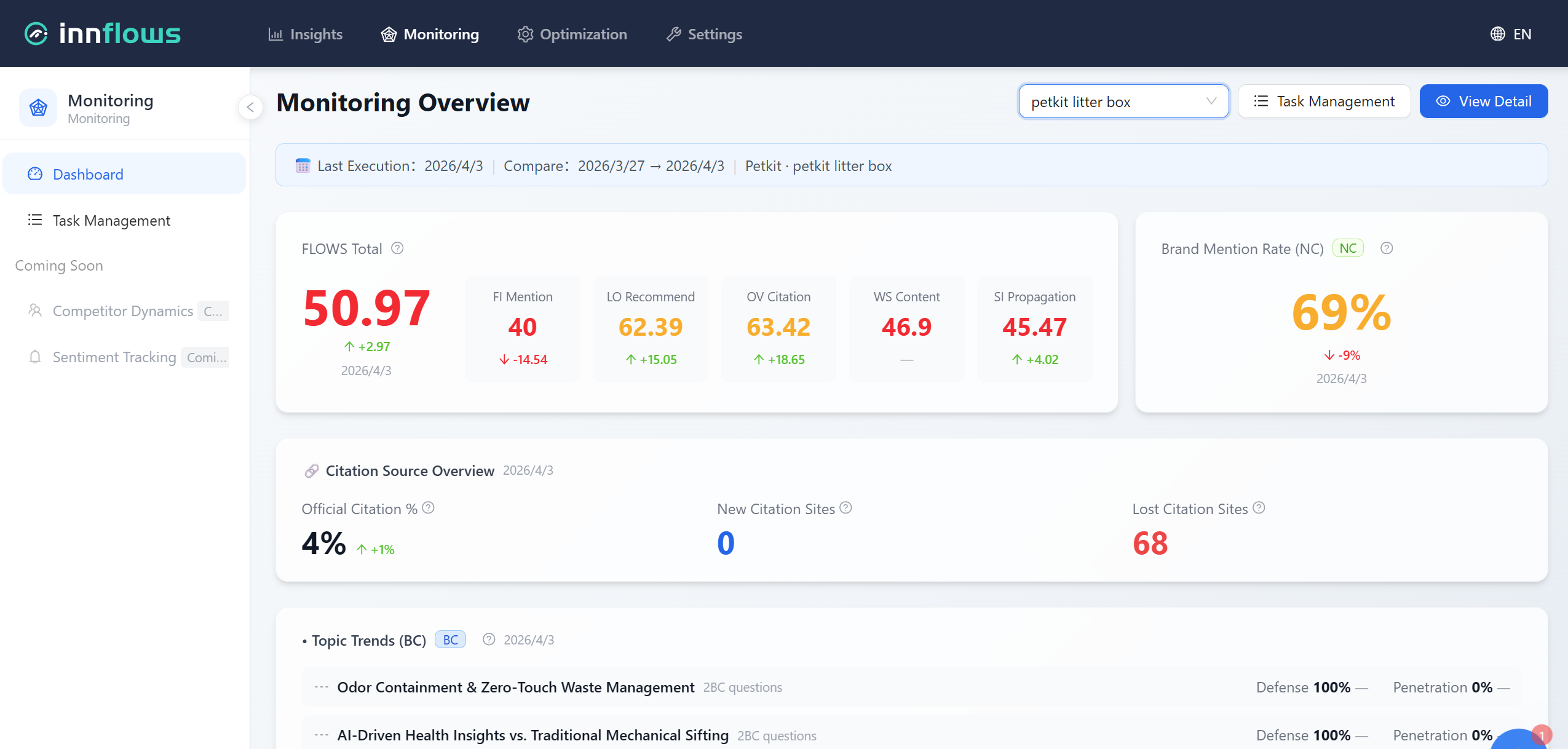
Image Source: Innflows
What Makes Innflows Stand Out
Innflows built its platform around a proprietary FLOWS Brand Trust Model that quantifies brand equity in AI systems. The platform operates an intelligent simulation system powered by a proprietary question generation model that simulates thousands of real users asking questions to major AI platforms. This approach captures brand performance in AI responses immediately and gives enterprise teams an evidence-based view of how their brand performs in generative search environments.
The platform measures brand trust through five distinct dimensions: Discovery Dimension, Recommendation Dimension, Citation Dimension, Content Dimension, and Propagation Dimension. Each dimension receives its own score and creates a radar chart that pinpoints specific shortfalls. Improving source authority is expected to boost the overall score by about 5%.
Innflows separates itself from point tracking solutions through the depth of evaluation. The system functions as an LLM-powered brand equity evaluation system that distills feedback from the AI industry into professional dashboards. Brands can customize the simulation engine for periodic monitoring based on their content optimization cycles.
Key Features and Capabilities
The five-dimensional framework provides granular insight into AI visibility performance:
- Find-ability Index Frequency of brand mentions in AI responses, position weight, and overall length proportion. — reflecting the brand's discoverability in AI responses.
- Leading Orientation Degree of recommendation in AI responses, plus informativeness and intent matching. — reflecting the strength of preference for the brand.
- Origin Verification Authority, credibility, and traceability coverage of brand information sources in AI responses. — reflecting the professional degree in AI responses.
- Website Structure AI-friendliness of brand websites and content carriers, and technical infrastructure completeness. — reflecting the trust degree of content construction.
- Spread Index The spread and distribution of the brand in public information environments like search engines and vertical platforms. — reflecting the brand's online coverage breadth.
The platform generates a five-dimensional radar chart to pinpoint shortfalls and auto-generates repair strategies. Teams manage AI brand assets similarly to Google Search Console and monitor Mention Rate and Sentiment immediately. The intelligent simulation system tracks brand performance on major AI platforms including ChatGPT, Google AI Overviews, Google AI Mode, Gemini, Qwen, Deepseek and Doubao.
Pricing and Best Use Cases
Innflows operates as an enterprise-focused solution with $99 Starter, $399 Pro, and custom enterprise pricing. The platform serves organizations with complex tracking needs spanning multiple brands, regions and product lines. Enterprise marketing teams, large agencies handling diverse client portfolios, and business owners with service and channel needs benefit most.
The monitoring cadence adjusts to match content optimization cycles, providing flexibility for teams with varying workflow requirements.
Pros and Cons
The proprietary FLOWS Brand Trust Model provides a structured, scientific approach to measuring AI visibility beyond simple mention counting. The five-dimensional framework identifies specific weaknesses and enables targeted improvements. Auto-generated repair strategies give teams practical next steps.
The intelligent simulation system captures real user behavior patterns, providing more realistic performance data than manual prompt testing. Monitoring Mention Rate and Sentiment immediately helps teams respond quickly to shifts.
The enterprise positioning means smaller teams may find capabilities exceed their needs. The custom pricing model lacks transparency for teams evaluating options without sales conversations. Limited public information makes it harder to assess fit before engaging with sales.
Profound: Multi-Platform Citation Analysis Tool

Image Source: www.tryprofound.com
What Makes Profound Stand Out
Profound captures real user-facing data from front-end interactions across 10+ AI engines including ChatGPT, Claude, Perplexity, Google AI Overviews, Gemini, Microsoft Copilot, DeepSeek, Grok, Meta AI, and Google AI Mode [8]. The platform shows exactly when, where, and how your brand is cited, pairing empirical answer snapshots with AI crawler behavior analytics.
Three proprietary data sets separate Profound from monitoring-only platforms. The platform sends millions of prompts daily to major answer engines, connects to website hosting providers via CDN integration to understand AI agent interactions across billions of data points, and licenses over 130 million real user conversations from GDPR-compliant data panels updated weekly [5]. Enterprise brands including Ramp, US Bank, Rippling, Indeed, MongoDB, Figma, Plaid, Chime, DocuSign, and Wayfair rely on Profound [16][5].
Key Features and Capabilities
Query Fanouts Analysis reveals how Answer Engines transform user prompts into multiple high-intent search queries before generating responses [8]. When someone asks which business bank account is best for startups, models fan out into queries like "best business checking accounts for startups 2026" and "startup bank account requirements." The page shows total query count, average queries per execution, word transformations, and period-over-period trends.
Shopping Analysis captures how products are found, described, and recommended inside Answer Engine shopping experiences [8]. The feature reveals product images, placement within conversations, competitive comparisons, and attributes AI assigns to products. Research shows products most frequently cited in AI shopping have richer content with more FAQs, videos, detailed specifications, and clearer URL structures.
Profound completed an independent HIPAA compliance assessment conducted by Sensiba LLP, enabling healthcare, pharmaceutical, and life sciences organizations to use generative engine optimization while maintaining full regulatory compliance [8]. The assessment validated AES-256 encryption at rest, TLS 1.2+ in transit, multi-factor authentication, role-based access controls, complete audit logging, and automated disaster recovery.
Citation Categories classify every cited domain into eight categories and reveal how much AI visibility comes from editorial coverage versus social mentions [17]. Analysis of 27 million citations shows brand citations represent 54-73% depending on the platform, meaning 27-46% of citations come from outside sources even on brand-specific prompts.
Pricing and Best Use Cases
Profound Lite starts from USD 499.00/month[8]. The Agency Growth plan costs USD 1,499.00/month with 10 pitch workspaces per month (25 custom prompts each) plus client workspaces (100 custom prompts each). Additional client workspaces are USD 399.00/month, with pitch workspace add-ons at USD 199.00/month for 5 more.
The platform serves enterprise organizations, regulated industries including healthcare, pharma, and finance, retailers, and agencies needing defensible AI visibility [8]. Client results show finance platform Ramp grew AI visibility 7x, doubled citations versus all previous content, and rose from the 19th to 8th most visible fintech brand [16]. Clients get a 97% increase in citation growth from AI engines by Day 80.
Pros and Cons
Front-end empirical data capture provides unmatched transparency into what AI systems surface. SOC 2 Type II and HIPAA compliance meet Fortune 500 security requirements [8]. Query Fanouts and Shopping Analysis address emerging needs in conversational commerce that competitors haven't built.
Premium pricing at USD 499.00/month makes Profound 48% more expensive than the market average [18]. The platform's technical sophistication comes with a steeper learning curve. Profound focuses on AI visibility monitoring and doesn't provide complete content creation capabilities. Organizations may need separate tools for traditional SEO analysis.
Writesonic: AI Content Generation with GEO Optimization

Image Source: Writesonic
What Makes Writesonic Stand Out
Writesonic connects AI visibility tracking, citation analysis and content optimization in one workflow. The platform analyzed 1M+ AI Overviews and found that 40.58% of AI citations come from Google's top 10 results [19]. This proves the overlap between traditional SEO and generative engine optimization.
Key Features and Capabilities
The platform tracks brand mentions, citations and share of voice across ChatGPT, Gemini and Google AI Overviews. Sentiment analysis shows how AI portrays your brand. The Prompts Explorer identifies gaps where AI answers questions but doesn't cite your content yet. The Action Center prioritizes recommendations based on effort and effect, moving beyond basic tracking to action-oriented insights.
Pricing and Best Use Cases
The Basic plan costs USD 199.00/month annually and tracks 100 AI prompts across 2 projects [20]. Growth runs USD 399.00/month annually (USD 499.00/month regular) and adds sentiment analysis with 200 tracked prompts. Enterprise offers custom pricing with unlimited tracking across all platforms. Marketers who want to build AI visibility without technical expertise will find this platform useful.
Pros and Cons
The tool was purpose-built to optimize generative engines rather than modernized from SEO tools. Visual dashboards make insights available, though engine coverage continues to expand. Custom pricing lacks transparency. Non-SEO teams face a learning curve despite the available interface.
Comparison Table: 5 Best Generative Engine Optimization Tools
| Attribute | Conductor | Semrush | Innflows | Profound | Writesonic |
|---|---|---|---|---|---|
| Main Focus | End-to-end enterprise GEO platform | Complete SEO with AI visibility features | All-in-one marketing platform in the AI field | Multi-platform citation analysis | AI content generation with GEO optimization |
| AI Platforms Tracked | Google AI Overviews, Google AI Mode, ChatGPT | ChatGPT, Perplexity, Google AI Overviews, Google AI Mode, Gemini | ChatGPT, Google AI Overviews, Google AI Mode, Gemini, Deepseek, Qwen, Doubao | ChatGPT, Claude, Perplexity, Google AI Overviews, Gemini, Microsoft Copilot, DeepSeek, Grok, Meta AI, Google AI Mode (10+ engines) | ChatGPT, Gemini, Google AI Overviews |
| Starting Price | $30,000-$150,000+ annually (custom pricing) | $99/month (AI Visibility Toolkit) or $199/month (Semrush One Starter) | $99/month (Starter) or $399(Pro) or Enterprise | $499/month (Profound Lite) | $199/month annually ($249/month regular) for Basic plan |
| Key Differentiators | OpenAI enterprise partner, 10+ years unified website data, MCP server integrations | Integration with existing SEO workflows, affordable entry point, applicable LLM-based recommendations | Proprietary FLOWS Brand Trust Model with 5-dimensional framework, intelligent simulation system | Front-end empirical data from real user interactions, 3 proprietary data sets, SOC 2 Type II & HIPAA compliant | Combines AI visibility tracking with content generation, analyzed 1M+ AI Overviews |
| Notable Features | AI Topic Map, Writing Assistant with Content Profiles, AI Crawler Activity monitoring, 24/7 technical SEO monitoring | Prompt Research tool, Competitor Research, Brand Performance analysis, Shopping Experience Tracking, Site Audit with AI-specific checks | Five-dimensional radar chart, auto-generated repair strategies | Query Fanouts Analysis, Shopping Analysis, Citation Categories (8 categories), real user conversation data (130M+ conversations) | Prompts Explorer, Sentiment analysis, Action Center with prioritized recommendations, visual dashboards |
| Best For | Enterprise organizations with multiple websites, complex content needs, dedicated SEO teams (retail, technology, healthcare, travel, finance) | Existing SEO teams adding AI visibility, small to mid-market businesses, SEO agencies managing multiple clients | Organizations with complex tracking needs across multiple brands/regions, business owners with service and channel needs | Enterprise organizations, regulated industries (healthcare, pharma, finance), retailers, agencies needing defensible AI visibility | Marketers building AI visibility without technical expertise, non-SEO teams |
| Key Limitations | No automated deployment features, no closed-loop tracking from changes to conversions, steep learning curve, premium pricing less available for small teams | Data resets every 7 days, no Excel export, no API for BI tools, only US English support, overwhelming for beginners | Enterprise positioning may exceed small team needs, custom pricing lacks transparency, limited public information | 48% more expensive than market average ($499/month), steeper learning curve, no complete content creation capabilities | Custom pricing lacks transparency, learning curve for non-SEO teams, expanding engine coverage |
Conclusion
Not every tool on this list will match your needs, and that's fine. Conductor works best for enterprise teams with substantial budgets, while Semrush offers an affordable entry point for businesses testing AI visibility. Innflows serves as an all-in-one marketing platform in the AI field with its five-dimensional framework, and Writesonic combines content creation with GEO monitoring.
Your specific choice depends on budget, team size, technical expertise, and whether you need standalone AI tracking or integrated SEO capabilities. Assess which features fit your actual workflow rather than choosing based on how complete they are alone.
Let me know in the comments which tool you're thinking over for your GEO strategy.
References
[1] - https://www.semrush.com/pricing/
[2] - https://www.semrush.com/blog/best-ai-visibility-tools/
[3] - https://www.semrush.com/blog/ai-search-optimization/
[4] - https://www.pymnts.com/acquisitions/2025/adobe-plans-to-acquire-semrush-to-add-geo-capabilities/
[5] - https://nicklafferty.com/reviews/profound-best-aeo-geo-platform-for-ai-search/
[6] - https://www.semrush.com/blog/top-ai-powered-semrush-features/
[7] - https://www.trustradius.com/products/conductor/reviews/all
[8] - https://www.tryprofound.com/blog/best-generative-engine-optimization-tools
[9] - https://www.g2.com/products/conductor/reviews?qs=pros-and-cons
[10] - https://www.madx.digital/learn/conductor-reviews
[11] - https://www.semrush.com/blog/how-to-optimize-content-for-ai-search-engines/
[12] - https://www.semrush.com/blog/best-generative-engine-optimization-tools/
[13] - https://www.amicited.com/blog/semrush-ai-visibility-toolkit-review/
[15] - https://www.softwareadvice.com/marketing/semrush-profile/reviews/
[16] - https://lift.comcast.com/from-seo-to-geo-how-profound-helps-companies-stay-visible-in-ai-search/
[17] - https://www.tryprofound.com/blog/enhanced-citation-categories
[18] - https://www.rankability.com/blog/profound-ai-review/
[19] - https://writesonic.com/blog/what-is-generative-engine-optimization-geo
[20] - https://docs.writesonic.com/docs/different-subscription-plans-of-writesonic