How Export Brands Can Claim Their Niche with GEO in the AI Era
How Export Brands Can Claim Their Niche with GEO in the AI Era
Brand moats used to be dug around shelves and trade-show booths. Now they also have to be dug inside the AI's answer.
At the latest session of the Guangzhou Google cross-border DTC training series, Innflows shared something already underway: the starting point of an overseas buyer's decision has moved from the search box to the question box.
A Training Session About the "Long Game"
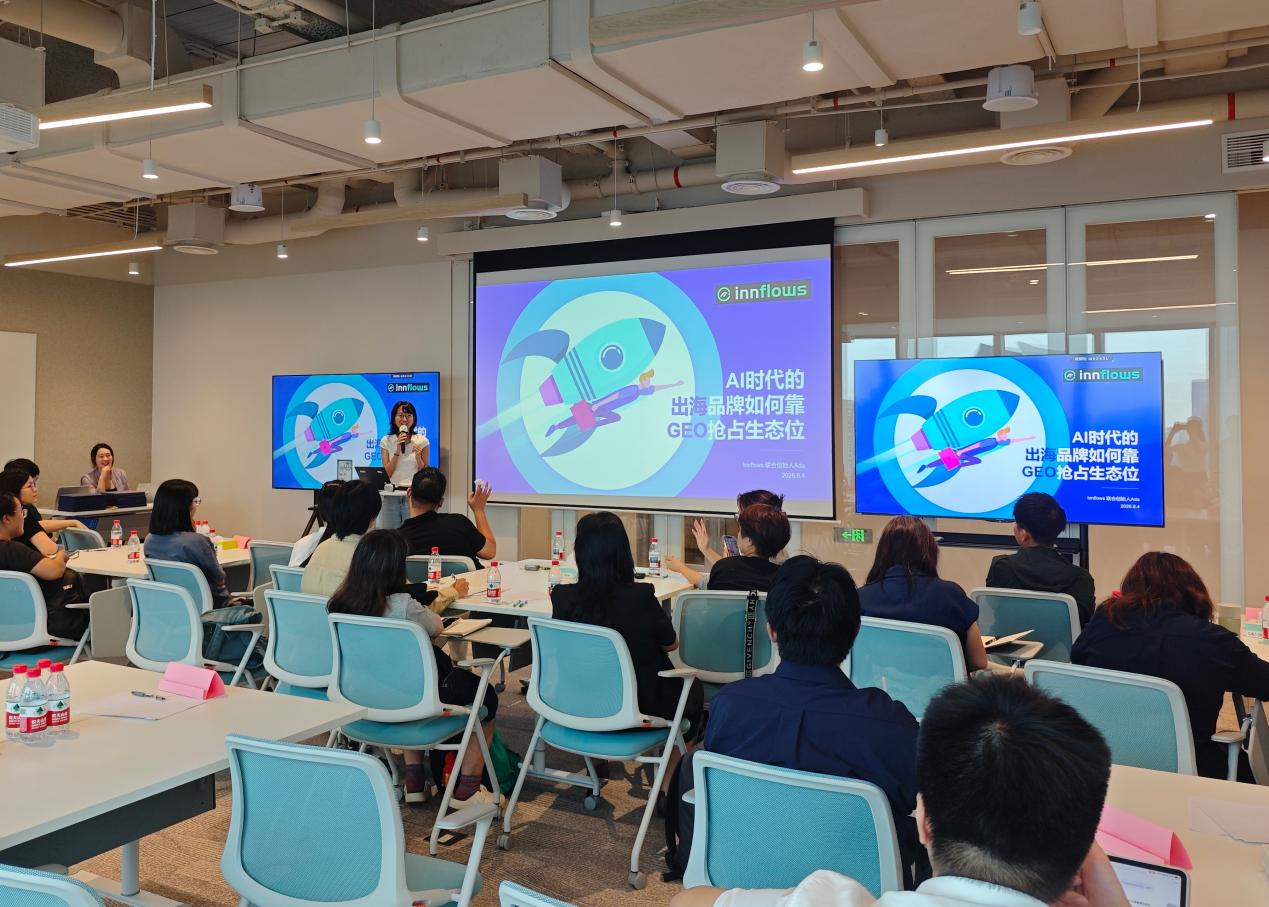
On the afternoon of September 4, 2026, Guangzhou Google Cross-Border DTC Training Series and "Guangzhou Premium Goods to ASEAN": Export Brands — Building a Brand Moat and Playing the Long Game was held at the Google Accelerator Center (Guangzhou). Hosted by the Guangzhou Foreign Economic and Trade Enterprise Association, it was the newest session in the series, focused on the core needs of export companies as they build brands, and organized around three directions: building brand awareness systems, a deep dive on GEO, and a course review.
The training supports Guangzhou's "Guangdong Goods Go Global · Guangzhou Premium Goods to ASEAN" digital export initiative. According to the Guangzhou Municipal Government portal, the 2026 program runs as one flagship launch plus 40 key trade-matching events, covering Vietnam, Indonesia, Malaysia, Thailand, the Philippines, and Cambodia; in 2025, trade between Guangzhou and ASEAN countries exceeded RMB 200 billion, up 28% [1].
Innflows was slotted into the "technology enablement" segment. That position matters: the sessions before it covered how to tell a brand story and how to buy traffic, while GEO answers a question that comes earlier still. When overseas buyers stop typing keywords and start asking AI directly, is your brand still on the shortlist?
In a Long B2B Decision Chain, the First Stop Is Now an AI Question
The opening session unpacked how trust gets built in B2B procurement. Overseas buyers run a long decision cycle: building brand awareness, searching for information online, then quotation talks, on-site inspection, and post-sale evaluation. Across the awareness, consideration, and purchase stages, companies need to match differentiated content — brand story, product highlights, success cases, customer service — to lower the buyer's perceived decision risk.
The first link in that chain is exactly where GEO operates.
Looking back at two decades of going global: Goods to the World (1999–2012) ran on price gaps, information gaps, and supply-chain sourcing; Efficiency Rules (2013–2019) competed on selection, traffic, and operational efficiency; Brands to the World (today) competes on omnichannel integration, and on whether you can become a brand overseas customers buy again rather than a one-time sale.
Innflows co-founder Ada (Wang Xiayi) put it bluntly: "E-commerce platforms only solve for answers, not for problems."
Buyers never ask a marketplace "how should I redesign this production line." They go to content platforms to resolve the problem first, land on a category answer, then return to the platform and search the category term. Everyone crowds onto the same head keywords, and traffic costs get pushed higher.
AI changes the "people find goods" path — overseas users increasingly ask ChatGPT or Gemini directly instead of scrolling results. The shift on the "goods find people" side runs deeper. Targeting used to rely on audience labels, and labels carry built-in data limits and subjective bias. Ada offered an example: very few men use tone-up cream, but a subset of cosplay enthusiasts do, because full foundation reads too stark. Or smart locks: people with long manicured nails are a genuine need segment, yet conventional targeting almost never notices them.
These highly specific audiences, hard to discover before, are exactly what AI can reach — because it has seen far more.
We used to use ads and labels to find people.
Now we use content to match the intent of potential buyers.
That is the foundational logic of GEO.
The Three Pillars of GEO: Intent, Content, Channel
Ada breaks GEO (generative engine optimization) into three things:
- Intent — what questions will buyers actually ask in an AI context?
- Content — how do you build content so AI trusts and ingests it?
- Channel — which media should carry that content so AI is more willing to cite you?
She was also candid about the industry's current pain points. "Ranking first" is not the same as "performing well" — a brand placed first on one question has not necessarily covered the real intent of most users in that category, and since answers vary by person and by run, asking once cannot represent the whole picture. Model data is closed, so how buyers actually phrase questions is known only to the model itself. And brute-force content volume deserves skepticism.
The Innflows Approach: Turning Guesswork into Calculation
First, calculate the intent
Unlike traditional SEO, which analyzes individual keywords, Innflows built a Full-Link Intent Simulation Engine. Drawing on a proprietary brand and industry knowledge base, it continuously pulls category, product-attribute, competitor-audience, and scenario VOC data from the Google search index, Reddit and Quora discussions, competitor whitepapers, and other sources, then models across three dimensions: buyer journey (a novice asks "what can it do," while someone near a decision asks "is this brand reliable, are there catches"), audience profile, and question paradigm.
From those three dimensions it abstracts Topics, splinters out a large volume of Questions, and simulates 10,000+ real users asking major AI platforms. After logging citation data in full, it outputs quantified, probabilistic results.
Quantify AI performance with the FLOWS five dimensions
Built on academic research, the FLOWS Brand Trust Model distills real-world AI feedback into a quantifiable "Brand AI Trust Score":
| Dimension | Full name | What it measures |
|---|---|---|
| FI · Find | Find-ability Index | Mention frequency, position weight, and share of length in AI answers |
| LO · Lead | Leading Orientation | Whether AI actually adopts your content to recommend you rather than a competitor |
| OV · Origin | Origin Verification | Authority, credibility, and traceability coverage of your sources |
| WS · Website | Website Structure | AI-friendliness of your site and content, plus technical completeness |
| SI · Spread | Spread Index | Breadth of brand distribution across public information environments |
The five dimensions form a radar chart: above 80 is strong, below 60 raises a warning, and the gap can be traced to content (WS) or recommendation (LO). For companies just starting a direct site, WS and OV usually break first — incomplete technical foundations mean AI cannot read key information, or every claim traces back to the company's own site with no third-party corroboration.
Produce content AI prefers, then monitor continuously
The Innflows content Agent works from E-E-A-T and two foundational GEO papers, covering formats from explainer to operating guide. In the Princeton paper that first proposed GEO, three test groups showed that AI-preferred content shares these traits: easy to understand, authoritative tone, appropriate technical terminology, fluency, precise citations, quotations, and statistics and arguments presented in tabular or structured form.
Asking once is nowhere near enough. Innflows monitors performance shifts across Topics and media on a recurring cycle, and delivers the raw data — which outlets mentioned you, and which competitors they mentioned — at fine granularity.
The Extra Layer in ASEAN: Test by Language
The same method gains a dimension in ASEAN: the market is not one country but six or more. Questions asked in Indonesian, Vietnamese, or Thai cannot be assumed to retrieve the same sources or produce the same answers as English. AI cites different local outlets and review sites in different language environments. Halal certification and ingredient labeling requirements also shape what content you can safely publish.
So AI visibility in ASEAN must be measured country by country and language by language. One aggregate score cannot represent all of Southeast Asia. Read the other way, that is the opportunity — most competitors have not tested by language yet.
One budget-relevant fact: OpenAI's publicly announced ChatGPT Ads markets include the U.S., Canada, Australia, New Zealand, and 31 European markets, and none of the named markets is an ASEAN country [3]. OpenAI has not published a complete list, so this does not mean ASEAN will stay closed. But on current public information, organic mention and citation are the main route for AI-surface visibility in ASEAN.
Three Things Google's Official Guide Rules Out
Since this was a Google-channel session, Google's own position deserves stating. Its official guide for generative AI search features rules out several popular tactics [2]:
- Do not build a page per phrasing. Creating separate content for every possible search variation, when done primarily to manipulate rankings or AI responses, violates Google's scaled content abuse spam policy and is ineffective long term — a high page count does not make a site higher quality.
- Do not worry about incomplete long-tail keyword coverage. AI systems understand synonyms and general meaning even when the page does not use the same precise words.
- Several "must-dos" are not required. No need to chunk content into tiny pieces, there is no ideal page length, and structured data is not required with no special schema needed — though it remains worthwhile as part of overall SEO.
What does work? The same guide places creating valuable, non-commodity content for your audience above every other suggestion for long-run impact, and illustrates a unique viewpoint this way: a first-hand review offers a perspective based on personal experience, whereas a summary of existing content simply restates what is already available.
This lands on the same conclusion as Ada's skepticism about volume: long-tail leverage comes from the breadth of real questions covered and the credibility of the answers, not from page count.
From Bootcamp to Certification: Digital, Branded, Precise
The third session reviewed the full arc of the cross-border DTC export bootcamp, consolidating the shared problems and practical challenges companies hit across direct-site build, ad campaigns, and localized operations, and mapping the core focus for each stage of an export roadmap against participants' differing maturity levels.
The session closed with a certification ceremony, awarding official completion certificates to representatives who finished the full program. Wang Jinghui, Secretary-General of the Guangzhou Foreign Economic and Trade Enterprise Association, congratulated the participants and noted that in a complex, shifting international market, digitalization, branding, and precision are the core paths for trade companies to break through growth ceilings — urging companies to apply what they learned, deepen online channels, and strengthen brand substance. The association will continue working with platforms including Google and LinkedIn to iterate the curriculum against real industry needs.
Ada closed by naming the difference between Innflows and its peers directly:
Many competitors ask a handful of questions once, then brute-force the whole thing at scale.
We use proprietary models and Agents to simulate intent, see your real performance probability in that category and that context, and then target media and content precisely from the insight data.
Closing Thought
"Building a brand moat and playing the long game" is a well-chosen title. Moats are never dug by a single campaign, and a long game is not covered by a single trade show.
On the overseas buyer's long decision chain, the first stop is a question. Whether your brand appears in that answer depends on what content you left behind beforehand, and which sources verified it.
Look upstream: at the people, the scenarios, and the questions above you.
As buyers shift from "searching for answers" to "asking AI," the contest for brand position moves off the shelf and out of the booth, into the answer itself.
---
About Innflows
Innflows is a technology platform focused on GEO (generative engine optimization) and AI visibility. Built on proprietary models and Agents, it helps export brands understand what consumers actually ask in AI contexts, quantify how the brand performs in AI answers, and produce content aligned with AI preferences — so brands get found, trusted, and recommended across ChatGPT, Gemini, Google AI Overview, Claude, DeepSeek, Qwen, and other answer engines. Brands including Laifen, Jackery, Violy, and Mango Classmate already use Innflows to improve their AI visibility.
Want to know how your brand performs in AI answers across ASEAN markets? Contact Innflows for a language-by-language AI visibility diagnostic.
---
References
[3] - ChatGPT Ads expands across Europe — OpenAI, August 18, 2026; the publicly announced ad market scope