Web Pages Do Not Enter AI Context Whole: How Filters Vital, Irrelevant, and Duplicate Spans
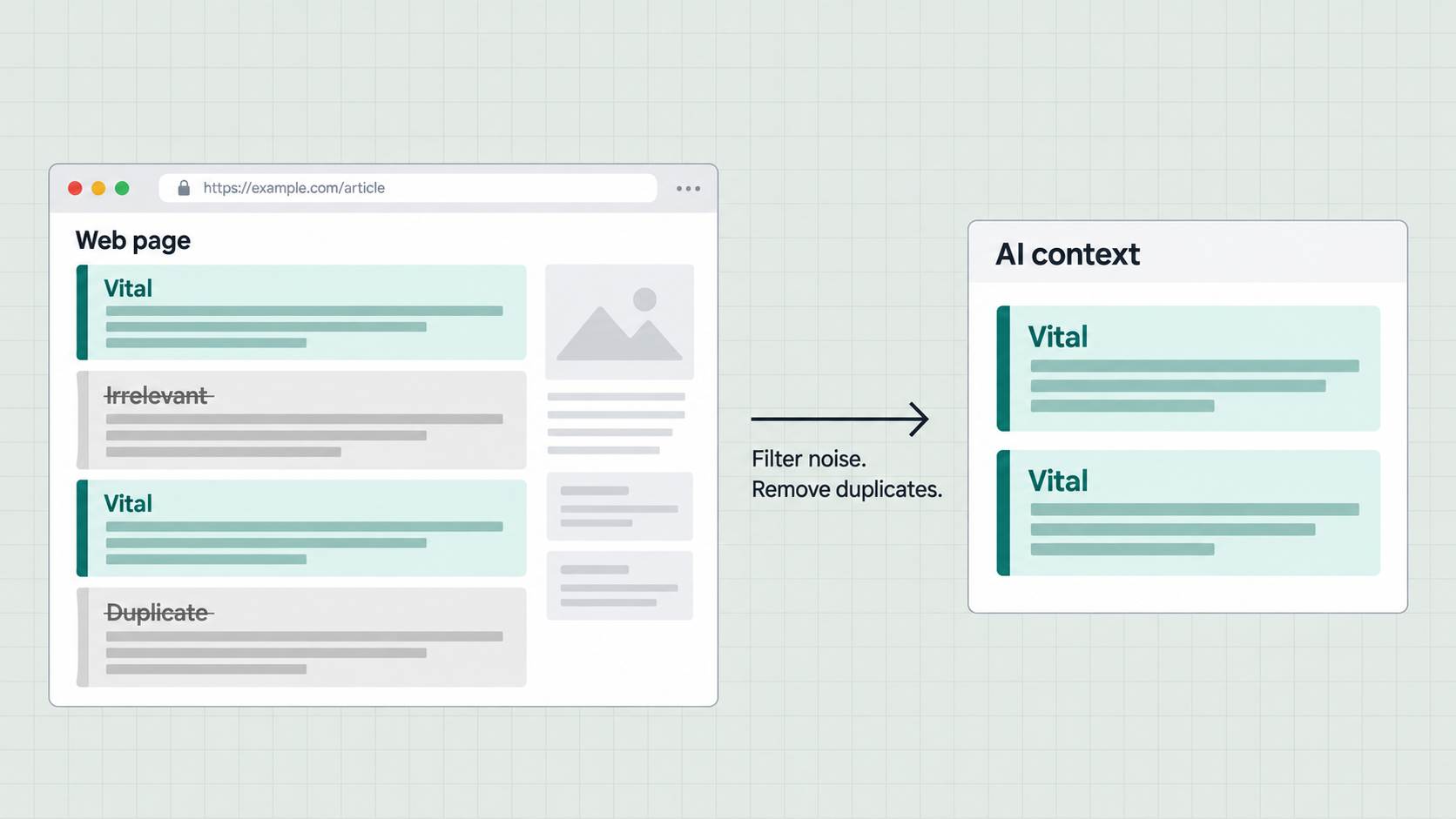
Web Pages Do Not Enter AI Context Whole: How Perplexity Filters Vital, Irrelevant, and Duplicate Spans
A search system can retrieve a page without sending the whole page to the answer model.
In March 2026, Perplexity described a new extraction and evaluation pipeline for its Search API. For each query-document pair, the system labels spans as vital evidence, several forms of irrelevant content, duplicates, and other categories. Two months later, Perplexity published the production design behind its query-aware context compression model, explaining how those granular labels become smaller snippets in its applications and API Platform [1][2].
The important change is not a new page-level score. It is a more precise layer between retrieval and generation: after a candidate page has been found, which local evidence deserves space in the model's limited context?
---
The Short Answer
Perplexity's disclosed flow can be summarized as follows:
Retrieve candidate documents, evaluate their original text against the current query, retain the evidence-bearing spans, remove off-topic and redundant material, and pass a smaller snippet to the answer model.
This is not the same as conventional chunking:
- Chunking determines how a document is segmented for processing, indexing, or initial retrieval.
- Query-aware extraction or compression decides which parts of already retrieved content matter for this specific question.
- Answer generation uses the surviving evidence to construct an answer and its citations.
Five boundaries are essential:
- “Span-Level Extraction” is not a standalone Perplexity product name. Its public materials use terms including span-level labeling, snippet extraction, and query-aware context compression.
- A page may be crawled and parsed in full without being passed to the answer model in full. This article is about downstream context, not whether the search system ever processed the page.
- Labels are query-dependent, not permanent page quality grades. A sentence can be off-topic for one request and vital for another.
- The published performance figures are Perplexity's own evaluations. They should not be generalized to Google, ChatGPT, Claude, or every Perplexity request.
- The mechanism does not require publishers to split pages into tiny fragments. Google explicitly says there is no generative-search requirement to “chunk” content into small pieces [9].
The durable content question is not “What is the ideal paragraph length?” It is: when only the most query-relevant source text survives, do the claim, scope, conditions, and evidence survive together?
---
What Perplexity Actually Changed
Each Perplexity Search API result can include a title, URL, snippet, publication date, and last-updated date. The snippet is not merely decorative copy; it is context intended for downstream models and agents [4].
Perplexity's 2025 Search API architecture article had already established the foundation. Its system retrieves and scores at both document and sub-document levels, treating sections and spans as first-class units. A document can be topically relevant while containing large amounts of text that do not help answer the current query [3].
The March 2026 update added two notable capabilities:
- a span-labeling pipeline that evaluates what a snippet should include and omit; and
- broader structured extraction for tables, nested lists, and dynamically rendered content that previous rules did not parse reliably [1].
The May follow-up disclosed the online compression model. Given a query and a candidate result, it selects source spans to retain and drops the rest. It does not write a fresh summary for every page. The output preserves source wording, supporting verification and citation alignment [2].
A More Accurate Processing Chain
| Stage | What the system handles | Important boundary |
|---|---|---|
| Retrieval | Candidate documents and sub-document units | Retrieval does not guarantee use in an answer |
| Parsing | Main text, tables, lists, layout, and structure | Missing crawl input cannot be recovered later |
| Span labeling | Local text value relative to the current query | A label is not a permanent page attribute |
| Snippet assembly | High-value source text within a token budget | A snippet is neither the full page nor a generated summary |
| Answer model | Filtered evidence used to compose a response | Citation still depends on additional model and product logic |
A span is a locatable range of source text. It should not automatically be equated with one paragraph, DOM node, sentence, or fixed token chunk. Perplexity creates supervision from copied spans, converts it to token-level keep/drop labels, and aggregates online predictions at sentence level before applying a threshold and token budget [2].
---
Six Content Categories: What Stays and What Goes
The March post referred broadly to vital spans, several irrelevant classes, duplicates, and other categories. The May evaluation named six snippet-token categories [1][2]:
| Category | Meaning for the current query | Common misreading |
|---|---|---|
| Vital | Evidence necessary to answer the request | The span is important for every query |
| Off-topic | Potentially useful information unrelated to this request | The content is low quality |
| Ads | Promotional material that does not help answer the request | All product information will be removed |
| Metadata | Ancillary information about the document | Dates and authors can never be evidence |
| UI & navigation | Menus, controls, and frontend navigation text | Semantic HTML has no value |
| Duplicate | Repetition of information already incorporated | The page has an SEO duplicate-URL problem |
The decisive phrase is for the current query.
A software page may discuss offline mode, pricing, data residency, and support. For “Can technicians complete work orders without connectivity?”, offline actions, supported platforms, and synchronization conditions may be vital. Pricing and support hours may be off-topic. For “What is the total cost of deployment in Germany?”, price assumptions and tax conditions can become vital while offline features move out of the core context.
The model is not creating a permanent list of “good paragraphs.” It is deciding, for every request, what counts as signal and what counts as noise.
---
How Span Labels Become Production Snippets
Perplexity's disclosed training and serving process has four main stages.
1. Understand possible query intents
The supervision pipeline uses an LLM judge to analyze the query and identify possible user intents. This reduces reliance on literal keyword overlap: evidence can satisfy an implied requirement without repeating the query's exact wording.
2. Copy and categorize spans from candidate content
The judge receives the candidate page's link, title, summary, and context, then returns verbatim source spans with inspectable categories. Perplexity reports that direct string matching recovered 98% of judge spans; a simple regex matching pass raised recovery to 100%. Those figures describe label alignment, not answer accuracy [2].
3. Convert categories into keep/drop supervision
Perplexity used the pipeline to label 750,000 query-document pairs. The spans were converted into token-level keep/drop supervision for a compression head. The rich categories help researchers inspect labels, while the production decision remains which tokens to retain.
4. Aggregate online predictions under a token budget
The model jointly reads the query and candidate context, making parallel predictions across the context. At serving time, the snippet engine aggregates predictions at sentence level, applies a threshold, and trims output to the requested token budget.
This explains Perplexity's choice of extractive compression rather than generated per-page summaries. Keeping source wording makes evidence easier to verify and cite. A generated summary may introduce language absent from the source while adding latency and cost [2].
Related research also formulates context pruning as sequence labeling that removes irrelevant material before generation, reducing long-context overhead and noise propagation [8]. Perplexity's system is a production implementation within that broader technical direction.
---
Why a Smaller Snippet Can Be More Accurate
More source text can feel safer, but long context does not guarantee reliable use of every piece of evidence.
The “Lost in the Middle” study found that model performance can fall when relevant information sits in the middle of a long context; models often use information near the beginning or end more effectively [7]. Perplexity identifies three costs of noisy context: lower accuracy, higher latency, and greater token expense [2].
Its reported internal results include:
- a distilled 17-layer production model with p99 latency below 20 milliseconds; compared with its 28-layer teacher, Perplexity reports 35%–40% lower inference latency and 40%–45% lower aggregate GPU compute without a compression-quality loss;
- 10%–70% lower query-level token use and accuracy gains of 4–4.81 percentage points in its BrowseComp multi-step evaluation;
- 95% accuracy for a medium SimpleQA preset using roughly 200 tokens per document, where source documents averaged more than 10,000 tokens; and
- across 1,000 mixed-domain validation queries, a 63% average increase in the proportion of vital tokens and a 29% reduction in irrelevant tokens; UI/navigation, metadata, and ads fell by 58%, 46%, and 43%, respectively [2].
These are vendor-reported results under Perplexity's models, traffic, benchmarks, and measurement choices. They do not establish a universal deletion ratio or prove that publishers should shorten their pages by the same percentages.
The system compresses what is passed to the model. It does not require the source page itself to be short.
---
What the Dynamic Benchmark Measures
The second part of the March update added SEAL to search_evals. It answers a different question from span labeling.
SealQA evaluates search-augmented language models when web results are conflicting, noisy, stale, or unhelpful. Seal-0 focuses on questions that baseline chat models almost never answer correctly; Seal-Hard expands the challenge; LongSeal adds long-context, multi-document distractors [6].
A February 24, 2026 snapshot of Perplexity's public repository runs 254 SEAL-Hard tasks through a single-step search agent and a SimpleQA grader, storing results for multiple search API and model combinations. That is an end-to-end answer-accuracy evaluation, not span precision, recall, or F1 [5].
Do Not Collapse Three Evaluation Layers
| Evaluation layer | Unit being observed | Question it answers |
|---|---|---|
| Span supervision | Human- or LLM-labeled query-responsive spans | Did the labeler identify evidence worth keeping? |
| Snippet composition | Tokens classified as vital, off-topic, ads, and so on | Did compression improve signal-to-noise ratio? |
| End-to-end benchmark | The search agent's final answer | Did the complete search-and-answer chain get the answer right? |
Perplexity states that when it ran the February 22 SEAL release with Claude Sonnet 4.5, its scores increased while other tested providers declined on SEAL-Hard [1]. This remains a vendor comparison in its own framework, not an independent industry ranking.
The benchmark's practical value is that it forces search systems to handle a moving web in which current answers coexist with obsolete pages and contradictory sources. For GEO, freshness is not merely a date field. The system must extract the current value from historical noise.
---
A Product-Page Example
Suppose a buyer asks:
Can FieldPro technicians complete work orders in Indonesia when they have no connection?
A candidate product page contains the following material:
| Page content | Possible label for this query | Why |
|---|---|---|
| “Android and iOS support creating, editing, and signing work orders offline; changes sync after reconnection.” | Vital | Directly answers offline capability, actions, and synchronization |
| “Offline mode requires version 2026.4 or later.” | Vital | A necessary condition for the claim |
| AI scheduling forecast features | Off-topic | Product-related but unrelated to offline work orders |
| Webinar registration banner | Ads | Promotional material unrelated to the answer |
| Author, reading time, and share controls | Metadata / UI | Does not support this answer |
| Footer repetition of “work from anywhere” | Duplicate | Repeats the capability without adding a condition |
FieldPro is a fictional product used only for illustration.
The principal risk is not page length. It is separating a headline claim from the conditions that make it true.
If “offline work orders supported” appears near the top while “version 2026.4+, attachments require connectivity” is buried in a distant note, a compressor could retain the broad claim without the limiting detail. Strong evidence design keeps the claim, subject, version, exception, and source close enough to survive together.
For a query about AI scheduling, the previously off-topic section could become vital. That change is the meaning of query-aware selection.
---
What Enterprises Should Change
1. Keep claims and limiting conditions in one evidence unit
A verifiable fact should, where practical, include its subject, action or value, unit, scope, time or version, and material exceptions. Do not let the hero section make a broad promise while a distant footnote carries the real boundary.
2. Reduce template noise around primary content
Navigation, repeated calls to action, campaign banners, recommendation widgets, and auto-inserted modules add parsing burden. They do not automatically cause a penalty, but they can consume extraction and context budgets. Make the primary content distinct in both HTML and visual hierarchy.
3. Preserve complete meaning in tables and lists
Perplexity specifically describes improved handling of tables and nested lists [1]. Headers, units, row-column relationships, and conditions should be expressed in readable text rather than color or position alone.
4. Replace repetition with additive evidence
Repeating the same claim in the hero, feature section, FAQ, and footer does not create four independent pieces of evidence. Use separate sections to add definitions, constraints, data, methodology, and sources.
Here, duplicate refers to context redundancy. It is not a reason to redesign canonical URLs or delete pages across a site.
5. Give time-sensitive facts an explicit current version
Prices, availability, product status, policies, and compatibility frequently conflict with old pages. Publish update dates, version numbers, applicable regions, and change histories. Clearly retire, redirect, or label obsolete guidance.
6. Run a Manual Six-Label Audit
Select one high-value buyer question and mark a relevant page as Vital, Off-topic, Ads, Metadata, UI/navigation, or Duplicate. Then read only the Vital sections and ask:
- Do they answer the question without missing context?
- Are the subject, unit, and date intact?
- Did the limiting conditions survive?
- Can each important claim be traced to a primary source?
- Would omitting everything else make the answer misleading?
This is not a replica of Perplexity's model. It is a content QA method derived from the disclosed mechanism.
---
Where Innflows Fits
Publishers cannot inspect Perplexity's internal span labels through its consumer interface or standard Search API reporting. They also cannot read undisclosed context decisions from other engines.
Innflows is better suited to the outcome layer. For a stable set of business questions, it can repeatedly record whether different AI platforms mention a brand, which URLs they cite, which claims appear in the answer, and how those outcomes change after content updates.
Combined with the framework in this article, a company can maintain a “question–critical evidence–source page–citation outcome” matrix:
- use buyer questions to identify the vital facts each page must preserve;
- audit whether claims, constraints, dates, and sources form complete evidence units;
- publish updates and repeat cross-platform tests; and
- prioritize evidence themes that remain absent or consistently go to competitors.
The boundary remains clear: external monitoring can observe answers and citations, not private token labels. It cannot prove that one span edit caused a citation change or guarantee that the next answer will cite the same page.
---
Six Common Misreadings
1. Perplexity permanently labels each page Vital or Irrelevant
It does not. The model reads both the query and candidate context, so the role of a span changes with the question.
2. Duplicate means duplicate content in SEO
Not here. It primarily refers to information already repeated in the selected context, not duplicate URLs, canonicalization, or site architecture.
3. The shortest snippet is always best
No. Compression trades precision against recall. Excessive pruning can remove necessary conditions, which is why Perplexity exposes thresholds and token budgets [2].
4. Extraction makes page structure irrelevant
The opposite is true. Parsing must correctly recover text, tables, lists, and layout before span selection has reliable input. A compression model cannot restore a fact that crawling or parsing never captured.
5. A SEAL score proves span-label accuracy
It does not. SEAL measures final answer accuracy. Span labeling and snippet composition are separate evaluation layers.
6. Perplexity's figures apply to every generative engine
They do not. Other engines may use different parsers, retrievers, pruning models, and context budgets.
---
Frequently Asked Questions
How is span-level extraction different from chunking?
Chunking commonly happens during preprocessing, indexing, or initial retrieval. Query-aware span extraction occurs after the query is known and candidate content has been retrieved, selecting the parts that matter for that request. Both can exist in the same system.
Is a span a sentence, paragraph, or DOM node?
The public materials do not define one permanent web-span unit. Training supervision starts with locatable source spans and becomes token-level keep/drop labels; online predictions are then aggregated at sentence level and constrained by a token budget [2].
Can publishers see which spans Perplexity labels as Vital?
No public webmaster report currently provides those internal labels. The Search API returns snippets but not the private category or selection score for each token [4].
How long should a paragraph be?
This work does not establish a universal word count. Perplexity optimizes a query-dependent snippet. Google also says pages do not need to be broken into tiny pieces for AI and that there is no ideal page length [9].
Will AI ignore tables and nested lists?
Not categorically. Perplexity says it expanded parsing across tables and nested lists, but any page still depends on crawl and parsing quality. Headers, units, and conditions should remain explicit in readable text.
Can better evidence units guarantee a citation?
No. They can improve the chance that content is interpreted and retained accurately at the extraction layer. A page must still pass crawling, indexing, retrieval, ranking, source selection, and generation stages.
---
The Bottom Line
Perplexity's engineering disclosures clarify a middle layer of AI search. Finding a relevant page is not enough; for every query, the system must decide which exact source text deserves room in the answer model's context.
Four conclusions matter:
- Vital, Off-topic, Ads, Metadata, UI/navigation, and Duplicate describe roles relative to a request, not permanent page grades.
- Extractive compression preserves source wording, supporting verification and citation traceability better than a generated per-page summary.
- Smaller snippets can reduce noise, latency, and cost, but aggressive pruning can also remove necessary conditions.
- Span supervision, snippet-token composition, and SEAL end-to-end accuracy are three distinct evidence layers.
The practical response is not to rebuild every article around a fixed chunk size. It is to keep each material claim close to its subject, scope, date, limitations, and primary evidence.
AI does not cite the abstract idea that an entire page is good. It cites the evidence that survives for the question being answered.
---
References
[1] - Search API: Better Extraction, Dynamic Benchmarks — Perplexity, March 11, 2026
[2] - Query-Aware Context Compression for Better Snippets — Perplexity Research, May 14, 2026
[3] - Architecting and Evaluating an AI-First Search API — Perplexity Research, September 25, 2025
[4] - Search the Web: Search API Reference — Perplexity
[5] - search_evals Repository Snapshot — Perplexity, commit dated February 24, 2026
[6] - SealQA: Raising the Bar for Reasoning in Search-Augmented Language Models — arXiv:2506.01062
[7] - Lost in the Middle: How Language Models Use Long Contexts — TACL / arXiv:2307.03172
[9] - Google's Guide to Optimizing for Generative AI Features on Google Search — updated July 10, 2026